

Inquiry
How to Choose the Right Battery Cell Format for Your ODM Project: Cylindrical vs Prismatic vs Pouch Cells
Choosing the right battery cell format is one of the first and most important decisions in an OEM/ODM lithium battery project. Whether you are developing a custom battery pack, residential energy storage system, UPS battery, medical device battery, or marine battery system, the cell format directly affects energy density, thermal performance, system layout, safety strategy, manufacturing cost, scalability, and long-term reliability.
The three most common lithium battery cell formats are cylindrical cells, prismatic cells, and pouch cells. Each format has its own strengths and limitations. For product brands and OEM/ODM customers, the key question is not simply “which cell is better,” but “which battery cell format best fits my application, system architecture, certification requirements, and market positioning?”
This guide compares cylindrical vs prismatic vs pouch cells from an ODM battery project perspective and explains how ACE Battery evaluates cell selection for customized battery packs and complete battery systems.
Understanding the Three Main Battery Cell Formats
Lithium batteries are usually built with one of three major cell formats: cylindrical, prismatic, or pouch. These formats differ in structure, packaging, space utilization, thermal performance, and pack design complexity.
Cylindrical Cells
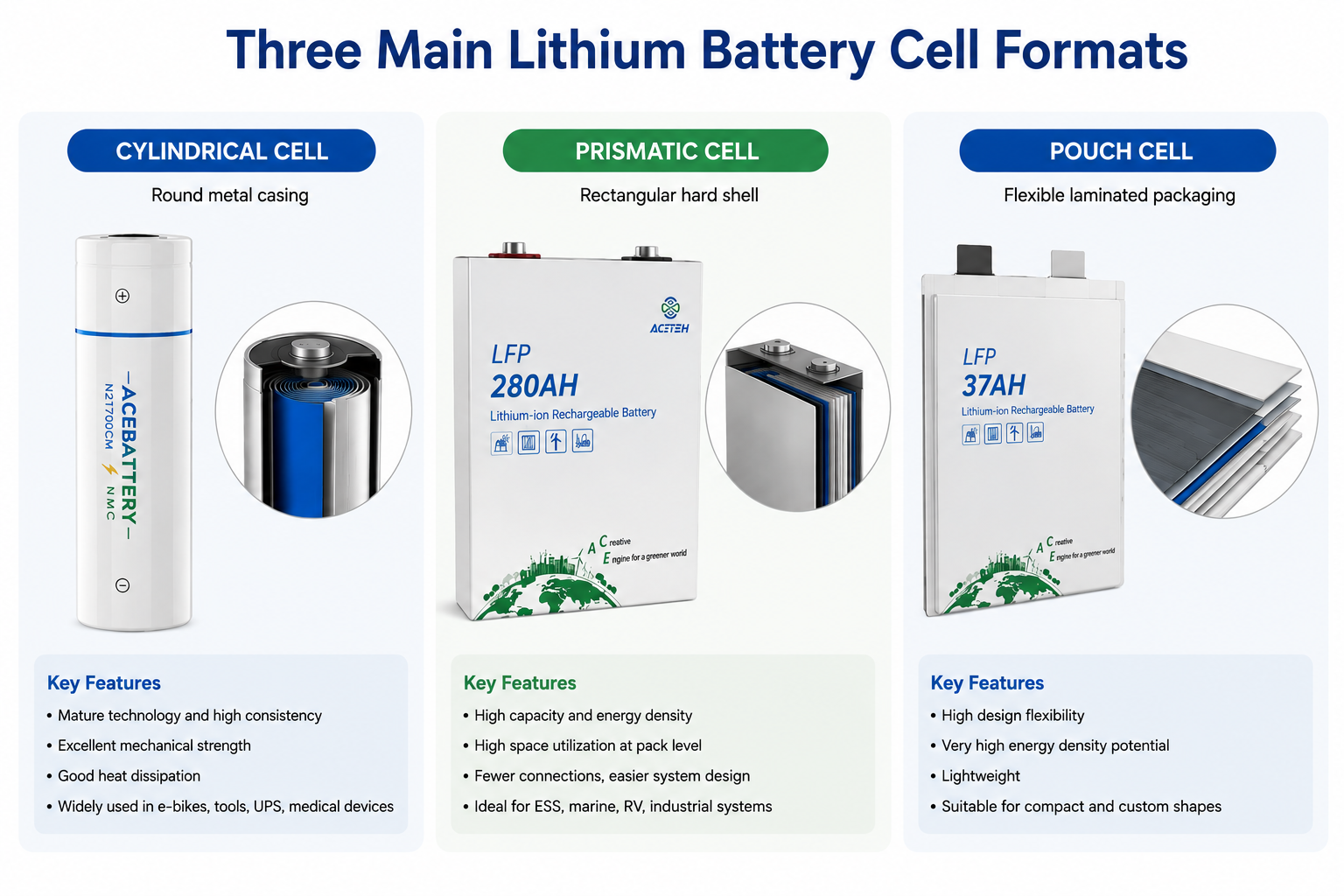
Cylindrical cells are among the most mature and widely used lithium battery cell formats. They use a rolled electrode structure enclosed in a rigid metal cylinder. Common sizes include 18650, 21700, and 4680 cells.
Because of their standardized shape and mature production ecosystem, cylindrical cells offer strong consistency, good mechanical protection, and excellent heat dissipation.
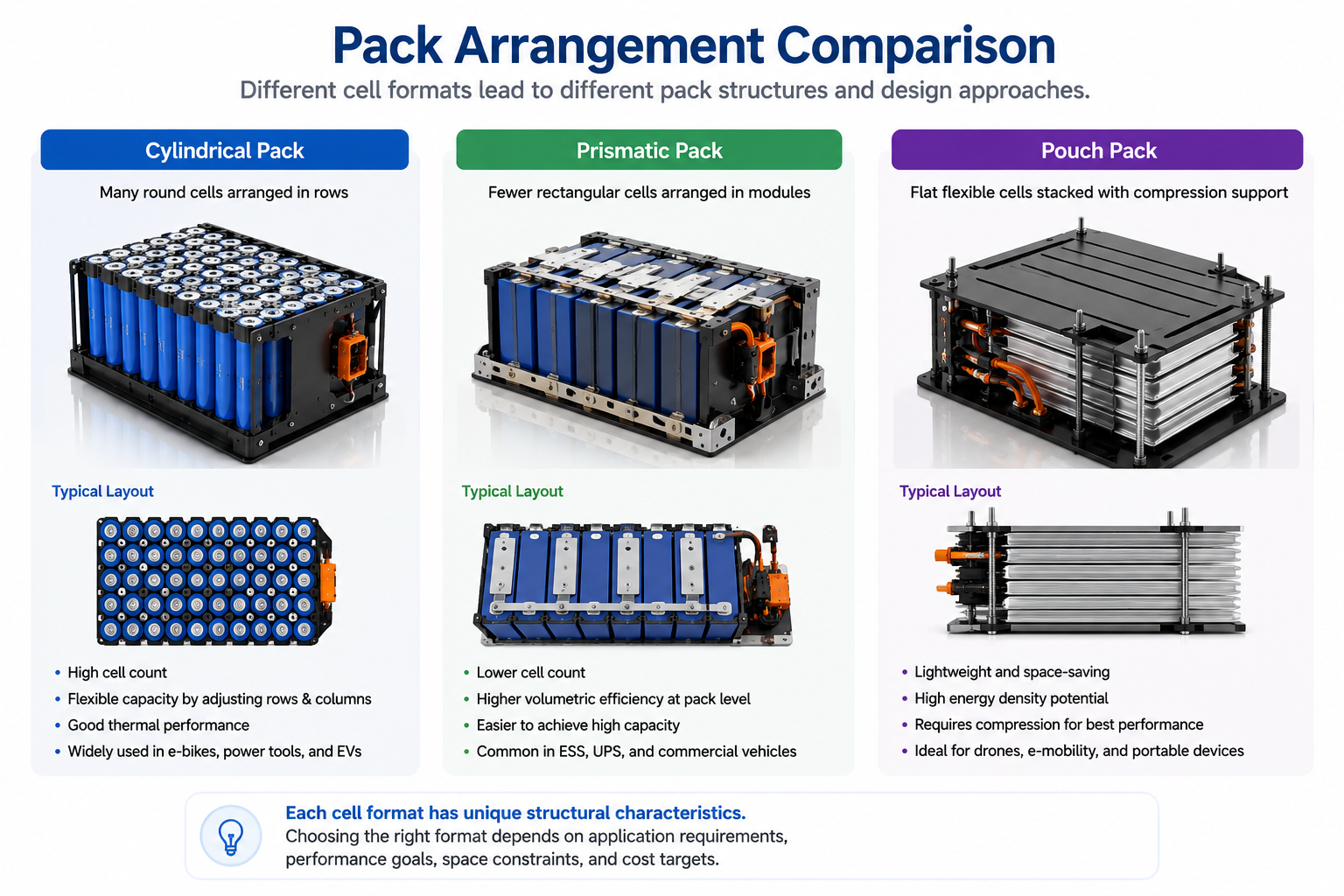
However, cylindrical battery packs usually require more cells and more interconnections, which can increase pack assembly complexity in higher-capacity systems.
Prismatic Cells
Prismatic cells use a rectangular aluminum or steel casing. Compared with cylindrical cells, they usually offer higher capacity per cell and better space utilization at the pack level.
Compared with cylindrical cells, they usually offer higher capacity per cell and better space utilization at the pack level.
In many battery systems, prismatic cells can reduce the number of cells and connection points, helping simplify pack architecture and improve packaging efficiency.
Pouch Cells
Pouch cells use a flexible laminated aluminum-plastic film instead of a rigid metal shell. This gives them high design flexibility and strong potential for high volumetric energy density.
They are often used in lightweight or space-constrained applications, such as consumer electronics, lightweight mobility products, and specialized medical devices.
The main challenge is that pouch cells require stronger external structural support. Swelling control, compression design, and thermal management are especially important in pouch-based battery pack design.
Cylindrical vs Prismatic vs Pouch Cells: What's the Key Differences?
Different battery cell formats should be compared from a system-level perspective, not only by cell-level performance. Energy density, cost, safety, assembly complexity, thermal behavior, and application fit all need to be considered together.
Factor | Cylindrical Cells | Prismatic Cells | Pouch Cells |
Typical Cell Examples | 18650, 21700, 4680 | Large-format LiFePO4/NMC cells | Flexible lithium pouch cells |
Mechanical Strength | Excellent | Good | Moderate |
Space Utilization | Moderate | High | Very High |
Thermal Dissipation | Excellent | Good | Moderate |
Pack Assembly Complexity | Medium-High | Medium | High |
Design Flexibility | Low | Medium | High |
Typical Cost Level | Low-Medium | Medium | Medium-High |
Common Applications | E-bikes, UPS, medical devices | ESS, marine, RV, industrial systems | Electronics, lightweight devices |
Typical Energy Density Comparison
Energy density varies depending on chemistry, manufacturer, design, and testing conditions. However, typical volumetric energy density ranges can help product teams understand general differences between cell formats.
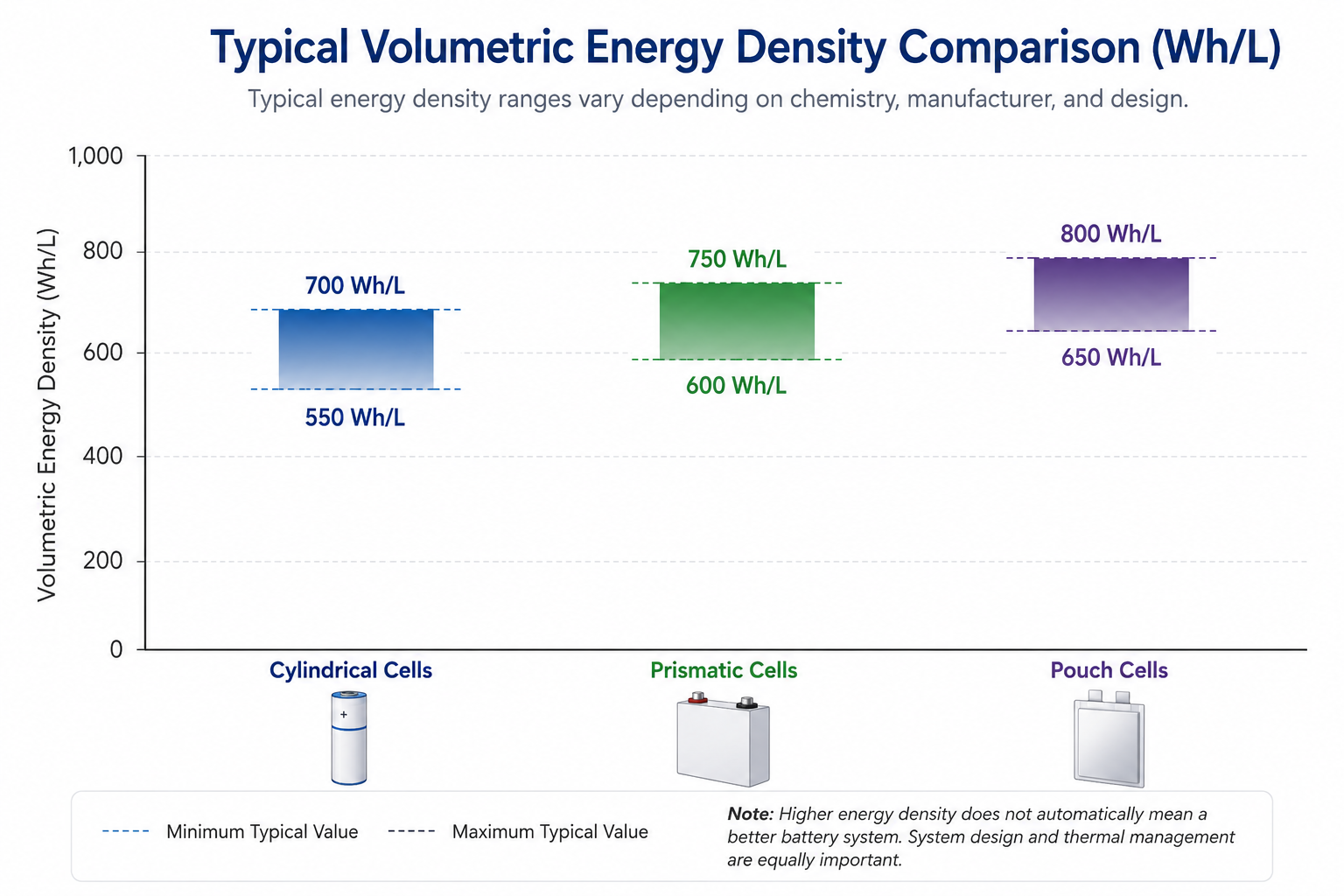
Important note: higher energy density does not automatically mean a better battery system. In real ODM battery projects, the final decision also depends on thermal safety, structural design, certification requirements, production scalability, and total system cost.
Which Battery Cell Format Fits Your Application?
The best cell format depends on the application. A battery used in a residential ESS has very different requirements from a battery used in an e-bike, UPS system, medical cart, or marine application.
Application | Recommended Cell Format | Main Reason |
Residential Energy Storage System | Prismatic Cell | High capacity, scalability, efficient pack layout |
Commercial & Industrial ESS | Prismatic Cell | Easier system integration and large-capacity design |
Marine Battery System | Prismatic Cell | High capacity in limited installation space |
RV Battery System | Prismatic Cell | Better space utilization and longer runtime |
UPS Battery System | Cylindrical or Prismatic Cell | Reliable backup performance and flexible design |
Medical Cart Battery | Cylindrical Cell | Mature safety performance and consistency |
E-bike Battery | Cylindrical Cell | Mature supply chain and cost efficiency |
Floor Cleaning Machine Battery | Prismatic Cell | Longer runtime within a compact footprint |
For many energy storage applications, prismatic cells are often preferred because they support high-capacity pack design while improving space utilization and reducing the number of interconnections.
Beyond Cell Format: What Actually Determines Battery Performance?
Many battery buyers focus heavily on cell selection. However, battery performance is ultimately determined by the complete battery architecture rather than the cell format alone.
Two battery packs using similar cells can perform very differently depending on the BMS, thermal design, structural design, manufacturing process, and quality control standards.
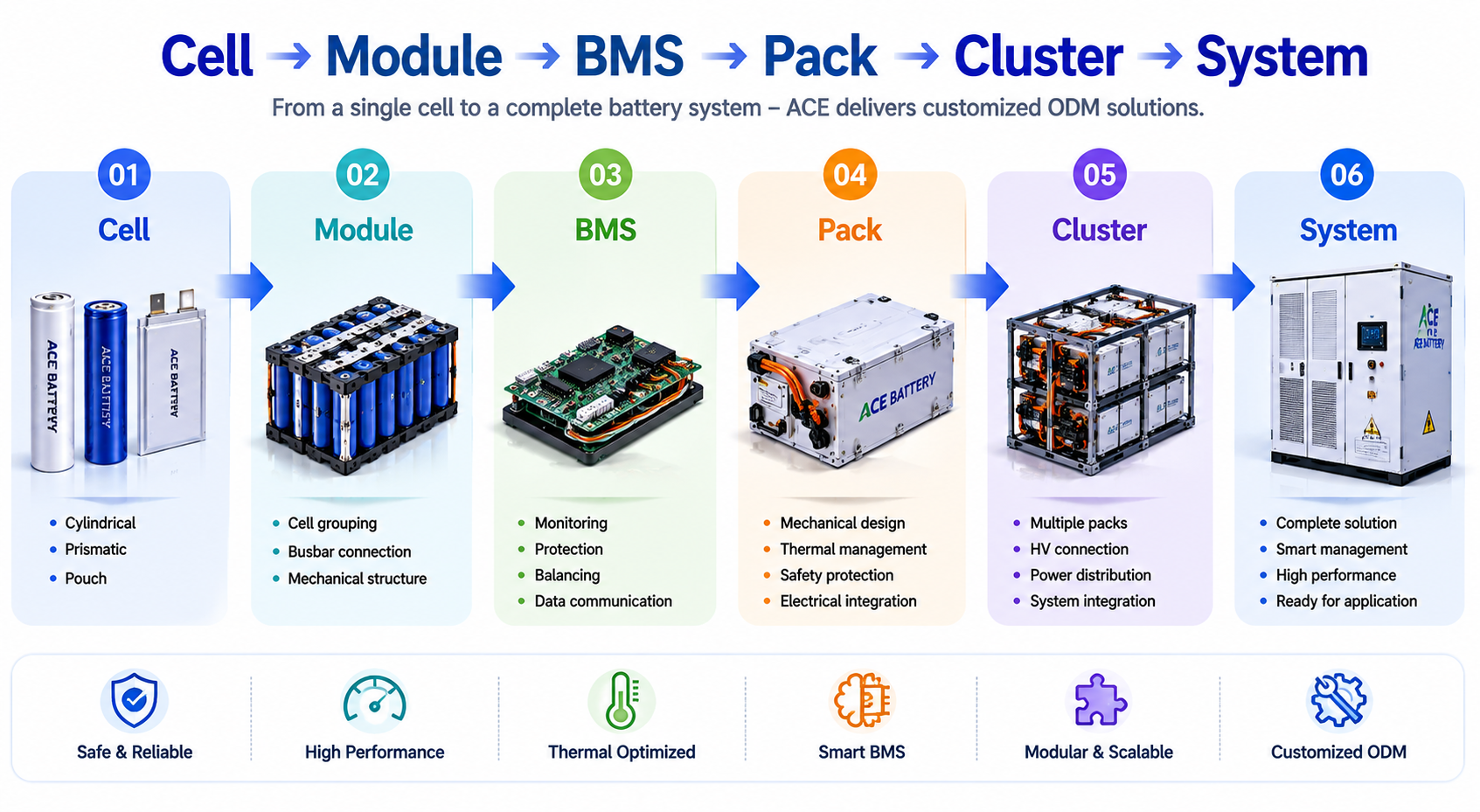
Battery Management System
The BMS is the control center of a battery system. It monitors voltage, current, temperature, SOC, and operating status. A well-designed BMS helps protect the battery from overcharge, over-discharge, short circuit, overheating, and abnormal operation.
For ODM battery packs, BMS design must match the application requirements, communication protocol, safety logic, and product usage scenario.
Thermal Design
Thermal performance is critical for lithium battery safety and cycle life. Good thermal design helps maintain temperature uniformity, reduce heat accumulation, and improve long-term reliability.
This is especially important for residential ESS, commercial energy storage, marine batteries, UPS systems, and other high-capacity battery applications.
Mechanical Structure
Battery packs must withstand vibration, shock, transportation, installation, and environmental stress. Mechanical design also affects waterproofing, impact resistance, serviceability, and overall product durability.
For outdoor ESS, marine, RV, and industrial battery systems, structure design is often just as important as cell selection.
Manufacturing Quality
Cell matching, welding quality, assembly precision, insulation design, testing process, and traceability all affect battery safety and performance.
This is why choosing an experienced ODM battery manufacturer is critical. A reliable partner should evaluate the full battery architecture rather than simply recommend one cell type.
How ACE Battery Selects the Right Cell Format for ODM Projects
At ACE Battery, cell selection is based on application requirements, system design goals, safety requirements, and mass production feasibility. We do not recommend a cell format based on a single parameter such as energy density or cost.
Application Requirements
ACE first evaluates the product’s voltage requirements, capacity targets, runtime expectations, peak power demand, and load profile. These factors establish the foundation for cell selection and overall battery architecture.
Space and Weight Constraints
The available installation space often determines whether cylindrical, prismatic, or pouch cells are more suitable. For compact systems that require higher capacity, prismatic or pouch cells may offer better packaging efficiency. For applications that need modularity and cost control, cylindrical cells may be more suitable.
Operating Environment
Temperature, humidity, vibration, outdoor exposure, and installation conditions all affect cell selection and pack design. Marine batteries, RV batteries, outdoor ESS, and industrial equipment usually require stronger environmental protection and structural reliability.
Safety and Compliance
ODM battery projects often need to meet specific certification and safety standards, such as UN38.3, IEC standards, UL-related requirements, or application-specific compliance needs.
The selected cell format must support the complete safety strategy, including BMS protection, thermal design, mechanical structure, and testing validation.
Through this evaluation process, ACE Battery helps customers develop custom battery packs and complete battery systems that balance performance, safety, manufacturability, and long-term cost effectiveness.
Conclusion
There is no single best battery cell format for every application. Cylindrical, prismatic, and pouch cells each have clear advantages depending on the project requirements.
Cylindrical cells are reliable, mature, and cost-effective for many mobile and compact battery applications. Prismatic cells are well suited for residential ESS, commercial and industrial ESS, RV batteries, marine batteries, and other high-capacity systems. Pouch cells offer excellent design flexibility and high energy density, but require careful structural and thermal design.
For ODM battery projects, successful battery development requires a system-level approach that balances cell selection, BMS design, thermal management, structural engineering, manufacturing quality, and certification planning.
Need Help Choosing the Right Battery Architecture?
ACE Battery develops custom battery packs and complete battery systems using cylindrical, prismatic, and pouch cells for applications including residential ESS, commercial and industrial ESS, UPS systems, medical equipment, marine batteries, RV batteries, two-wheeler batteries, and industrial equipment.
Contact ACE Battery’s engineering team to discuss your ODM battery project and identify the most suitable battery solution for your application.
Our expert will reach you out if you have any questions!