

Inquiry
UL 9540A Large-Scale Fire Test Certification: ACE’s Three-Level Lithium Iron Phosphate Energy Storage System Strengthens Data Center Fire Safety
Data centers host critical computing infrastructure and vast quantities of business-critical data. A thermal runaway event in a lithium-ion battery energy storage system (BESS) can trigger a cascading sequence of failures, ranging from equipment downtime and data loss to substantial financial losses and, in the worst case, a large-scale fire with severe safety consequences.
With the introduction of the sixth edition of UL 9540A, installation-level large-scale fire testing (LSFT) has become an important compliance requirement for indoor energy storage applications. Cell-level fire performance alone is not sufficient to demonstrate system-level safety. Effective protection must prevent fire propagation across modules, racks, and adjacent equipment within the data center.
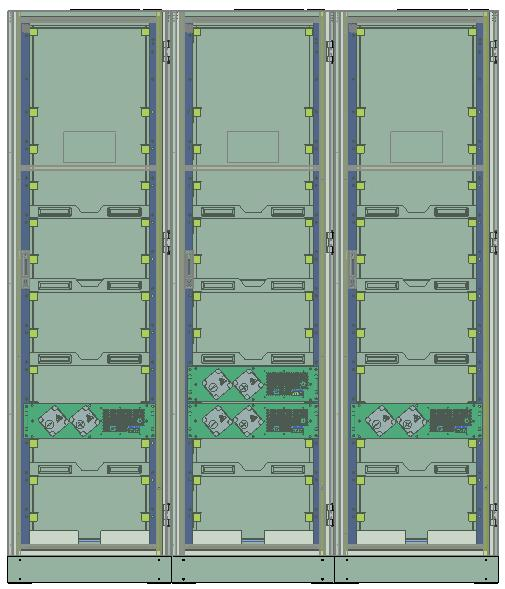
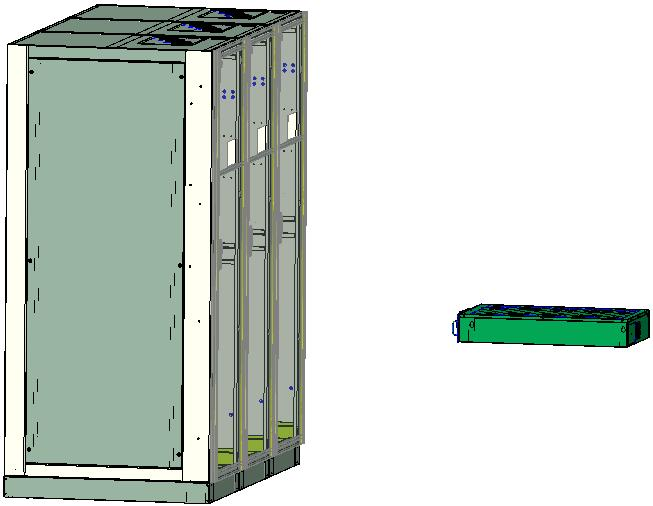
ACE’s internally developed three-level lithium iron phosphate (LFP) energy storage architecture establishes a multilayer fire-safety barrier spanning the cell, module, and rack levels. The system has successfully completed UL 9540A installation-level large-scale fire preliminary testing, demonstrating a comprehensive approach to thermal runaway containment and fire propagation control for high-density data center deployments.
 |  |
I. Cell-Level Safety: Inherently Stable Lithium Iron Phosphate Chemistry
LFP cells provide a stable electrochemical foundation for thermal management and fire-risk mitigation. Compared with ternary lithium-ion chemistries, LFP’s olivine crystal structure exhibits greater thermal stability and limits the release of reactive oxygen during thermal runaway, reducing the conditions that can contribute to rapid combustion.
ACE’s cell-level safety design incorporates the following features:
- Low-heat-release cell formulation: The formulation is designed to reduce total heat release during a cell-level thermal runaway event, helping keep the heat generated by a localized fault within a controllable range.
- High-consistency cell grading and sorting: A rigorous screening process identifies and removes cells with abnormal internal resistance or voltage characteristics, reducing the likelihood of latent defects that avoiding internal short-circuit causes.
- Ceramic-composite separator and high-temperature-resistant electrolyte: These two protective measures increase thermal stability and delay the onset and escalation of thermal runaway. During the UL 9540A fire test, the triggered cell underwent thermal runaway and ignited gradually, with no instantaneous deflagration or ejection of high-temperature molten debris, thereby reducing the initial thermal and mechanical drivers of fire propagation.
II. Module-Level Isolation: Four-Layer Protection to Contain a Localized Fire
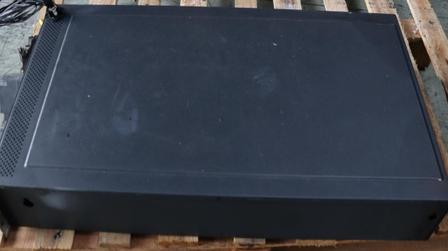
The module represents a critical intermediate barrier against heat and fire propagation. ACE integrates thermal insulation, compartmentalization, and controlled pressure relief to create an independent fire-resistant enclosure for each module.
- Serpentine cell arrangement and thermal-resistance gradient: Thermal-insulation channels are incorporated between cells, while materials with graded thermal resistance progressively reduce lateral heat transfer and help prevent adjacent cells from reaching ignition conditions.
- High-temperature-resistant composite insulation: The module is encapsulated with fire-resistant thermal-insulation materials designed to withstand extreme temperatures and limit radiative heat transfer between adjacent modules.
- Directional gas venting and oxygen-limiting pressure control: Combustible gases generated during thermal runaway are directed away through dedicated discharge paths. A controlled micro-positive-pressure environment within the module also helps limit external oxygen ingress and suppress sustained combustion.
- Independent sealed compartments: Each module is physically isolated so that heat generated by combustion in one module is contained within its compartment and is not readily transferred to adjacent modules.
Large-scale fire test results demonstrated that, after the trigger module was ignited, combustion remained localized and progressed gradually. Adjacent modules within the same cabinet showed no observed fire or thermal runaway, while cell voltage and temperature remained within normal operating ranges. These results support the system’s objective of preventing thermal runaway propagation between modules.
III. Rack-Level Fire Protection: Containing Propagation Across Adjacent Racks
In high-density data centers, closely spaced racks create a potential pathway for heat and smoke to spread from one energy storage cabinet to another. ACE’s rack-level thermal-protection architecture provides an additional layer of containment.
- Fire-resistant and thermally insulating interlayers: High-strength fire-resistant insulation is incorporated into the cabinet structure, with independent fire barriers between cabinets to limit high-temperature radiation and smoke migration.
- Integrated pressure-relief and exhaust pathways: Dedicated channels direct high-temperature combustion gases away from adjacent cabinets and the main data center circulation areas.
- High-strength fire-resistant sheet-metal enclosure: The cabinet structure is designed to maintain its integrity under severe thermal conditions, reducing the likelihood of deformation, cracking, or flame escape into common equipment areas.
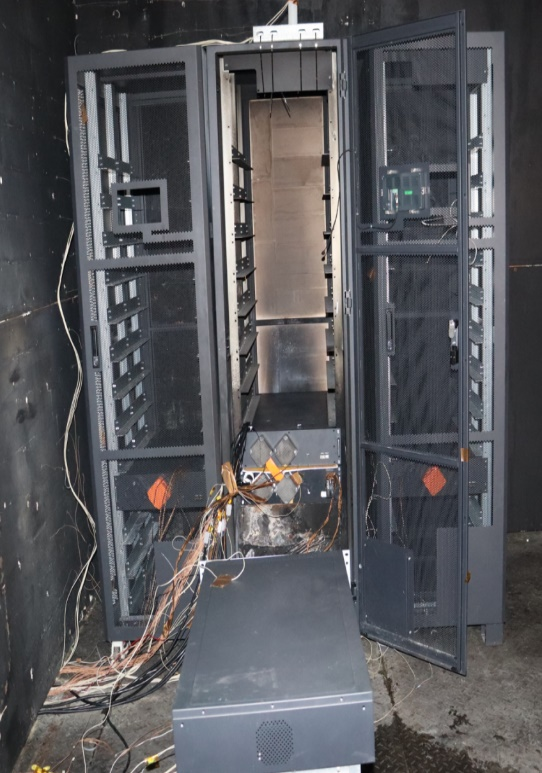
During the UL 9540A rack-level large-scale fire test, a module in the trigger rack was intentionally subjected to thermal runaway and burned. The adjacent target racks showed no observed open flame or thermal runaway, and the battery modules within those racks remained undamaged. The results demonstrate effective containment of fire propagation under the tested configuration.
IV. UL 9540A Large-Scale Fire Test Verification: Comprehensive Evidence of System-Level Safety
The test was conducted in accordance with the UL 9540A sixth-edition installation-level large-scale fire test methodology, using a configuration intended to represent a data center application, including full system power and multiple racks installed side by side. Active fire-suppression systems were disabled during the test to increase the severity of the thermal runaway scenario.
Key test observations included:
- The triggered battery cell underwent thermal runaway and ignited gradually, with no explosion or ejection of high-temperature debris observed.
- Adjacent modules within the same cabinet exhibited no observed fire or thermal runaway, and their cell operating parameters remained within normal ranges.
- Adjacent target racks showed no observed high-temperature penetration into the rack enclosure, and no fire or thermal propagation was observed within their battery modules.
- Following combustion, no re-ignition was observed. The trigger cabinet is structurally intact, and adjacent cabinets can be directly reused.
Where many industry solutions focus on testing at only one or two levels of the battery system, ACE’s approach extends UL 9540A large-scale fire testing across the cell, module, and cabinet/rack levels. This multilayer validation can support fire-safety review and compliance documentation for data center energy storage projects in North America and China, while helping streamline fire-protection assessments and reduce the need for subsequent system modifications.
V. Application Value Across Data Center Scenarios
- High-density deployment: The system’s integrated fire-containment architecture can reduce reliance on large additional fire-separation zones, helping preserve valuable data center floor space and support higher energy storage density.
- Potentially lower fire-protection complexity: Passive thermal-insulation and flame-resistant structures can complement site-level active fire-protection measures and may reduce the need for additional dedicated equipment, subject to applicable codes, standards, and authority requirements.
- Controlled operation and maintenance risk: By limiting faults and fire events to localized modules or cabinets, the architecture is designed to facilitate targeted incident response and minimize unnecessary disruption to the broader data center.
- International compliance support: A completed UL 9540A large-scale fire test report can provide important technical documentation for overseas data center deployments and cross-border infrastructure projects, subject to local regulatory approval.
- Long service life of LFP technology: LFP chemistry combines strong thermal stability with long cycle life, making it suitable for applications requiring both 24/7 backup power and peak-shaving/valley-filling energy storage.
Conclusion
Energy storage safety is not a single-point protection challenge; it is a system-engineering discipline that extends from the battery cell to the complete data center environment. ACE’s three-level LFP energy storage architecture combines cell-level thermal control, independent module isolation, and rack-level fire containment to address the risk of cascading fire caused by thermal runaway.
Supported by UL 9540A large-scale fire test results, this multilayer safety architecture is designed to help data centers achieve a practical balance of deployment density, compliance readiness, operational resilience, and fire safety. For critical computing infrastructure and business-critical data, ACE provides an energy storage safety approach built around containment, controlled propagation, and system-level verification.
Our expert will reach you out if you have any questions!