

Inquiry
Thermal Protection Strategies in Custom Residential Lithium Battery Packs by ACE Battery
As residential energy storage systems move toward higher energy density, longer backup duration, and faster charging, thermal protection has become a core aspect of lithium battery pack design. Unlike portable batteries, residential ESS packs often operate continuously in enclosed indoor or semi-outdoor environments, where heat gradually accumulates during cycling or abnormal conditions.
Thermal runaway — when heat from one cell spreads to neighboring cells — is a major safety risk. Preventing it requires multiple internal protection layers that slow heat transfer, isolate hotspots, and allow safety systems to respond effectively. ACE Battery integrates mica insulation, BMS potting, thermal barriers, reinforced wiring, laser-welded tabs, and fire suppression systems to ensure residential ESS battery packs are safe, reliable, and long-lasting.
Why Thermal Runaway Protection Matters in Residential ESS Battery Packs
Thermal stress in residential ESS packs often concentrates around cell connections, busbars, wiring, BMS modules, and power terminals. These areas are critical for current flow, signal transmission, and protection monitoring.
If heat is not controlled, thermal propagation can spread from one cell to adjacent modules, potentially affecting system stability. Because residential ESS systems are installed near living spaces, slowing this propagation is essential for safety. ACE Battery addresses these risks during the structural design stage, carefully selecting insulation materials, arranging thermal barriers, protecting wiring, and designing pack-level safety features before assembly.
Why ACE Uses Mica Tubes Instead of Standard Insulation Paper
What Is a Mica Tube in a Residential ESS Battery Pack?
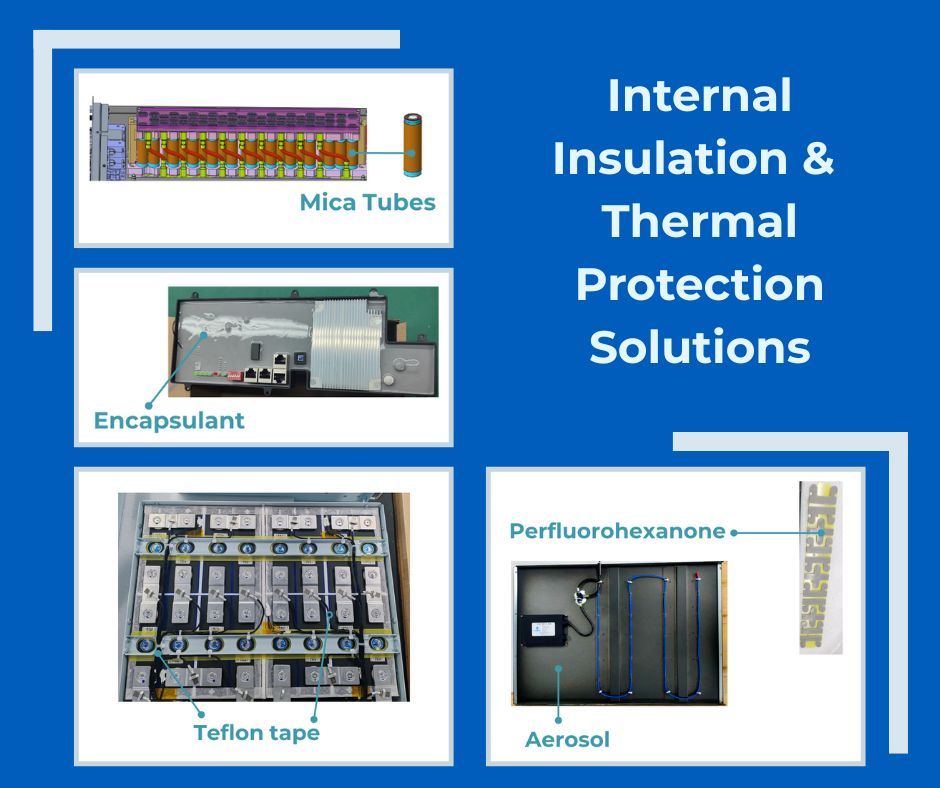
A mica tube is a high-temperature-resistant sleeve wrapped around cylindrical battery cells. Compared with conventional insulation paper, mica offers superior thermal resistance and flame-retardant performance. In high-energy residential ESS battery packs, this ensures better control of thermal propagation, especially in densely packed modules where heat accumulation is more likely.
Mica maintains structural stability under extreme heat and continues to provide electrical insulation during abnormal events, giving safety systems extra response time.
Why Mica Performs Better Under High Thermal Stress
Mica can tolerate temperatures above 1000°C, providing lower thermal conductivity, enhanced flame resistance, stronger thermal isolation, and higher structural stability compared with standard paper. In residential ESS applications, these benefits help delay cell-to-cell heat transfer, allowing BMS monitoring, current interruption, system shutdown, and fire suppression systems to act effectively. Even a few seconds’ delay can significantly improve overall system safety.
Feature | Mica Tube | Standard Insulation Paper |
Heat Resistance | Excellent | Moderate |
Flame Retardancy | High | Lower |
Thermal Isolation | Strong | Limited |
Structural Stability | Excellent | Moderate |
Why BMS Potting Matters in Residential Energy Storage Systems
What Is BMS Potting?
BMS potting encapsulates the Battery Management System with insulating compounds to protect it from thermal stress, moisture, dust, and vibration. The BMS monitors voltage, current, temperature, charge/discharge behavior, and overall system protection.
How Potting Improves Safety and Reliability
Potting isolates sensitive electronics, reduces arcing, enhances moisture resistance, improves vibration durability, and lowers thermal exposure. Residential ESS systems often operate continuously in garages, basements, or utility rooms with fluctuating temperature and humidity. Potting ensures long-term stability and helps the BMS reliably manage thermal and electrical safety over the system’s lifetime.
Why Communication Wires Use Teflon and Fiberglass Protection
Internal Wiring as a Thermal Risk Point
Communication wires transmit critical signals between cells, temperature sensors, the BMS, and protection circuits. In residential ESS battery packs, these wires operate continuously for years and play an important role in system monitoring and protection.
Inside compact battery enclosures, heat may gradually accumulate around busbars, terminals, and densely packed wiring areas. Over time, elevated temperatures can accelerate insulation aging, potentially leading to communication instability, signal interruption, or electrical short circuits. If communication signals become unreliable, system monitoring accuracy and protection response performance may be affected.
For residential ESS battery systems expected to deliver long service life with minimal maintenance, internal wiring protection is an important part of overall thermal safety design.
Why ACE Uses Teflon and Fiberglass Protection
Compared with standard insulation materials, Teflon offers several advantages for residential ESS battery applications. It maintains stable insulation performance under elevated temperatures, resists long-term degradation caused by thermal cycling and environmental exposure, and provides excellent durability during transportation, installation, and long-term operation.
To further improve protection, ACE Battery may also apply fiberglass sleeving around communication wiring in selected battery designs. Fiberglass adds flame resistance, thermal shielding, and mechanical reinforcement, helping maintain insulation stability under thermal stress.
By combining Teflon insulation with fiberglass protection, ACE Battery enhances wiring durability, preserves signal integrity, and reduces thermal-related failure risks throughout the battery system lifecycle.
Why Laser-Welded Tabs Matter in Residential ESS Battery Packs
Stable cell connections are critical for controlling electrical resistance, current flow, heat generation, and long-term cycling performance. In residential ESS battery packs that undergo daily charging and discharging cycles, even small increases in connection resistance can gradually create localized hotspots and contribute to thermal stress over time.
To improve connection quality, ACE Battery uses laser-welded tabs to achieve low-resistance, highly consistent connections across multiple cells. Compared with some traditional joining methods, laser welding helps maintain stable current distribution, reduce unnecessary heat buildup, and improve manufacturing consistency throughout the battery module.
Laser-welded connections also provide strong mechanical stability under long-term thermal cycling, helping reduce connection degradation risks over years of operation. By improving both electrical and thermal performance, laser welding contributes to the overall reliability and safety of residential ESS battery packs.
How Thermal Insulation Filling Slows Cell-to-Cell Heat Propagation
Thermal insulation filling is strategically applied between cells, between modules, near high-temperature zones, and around structural thermal barriers. By placing insulation in these key areas, ACE Battery ensures that heat transfer pathways are interrupted and hotspots are isolated within the battery pack.
This arrangement slows the propagation of heat from one cell or module to adjacent areas, providing critical extra time for protective mechanisms. BMS monitoring, system shutdown protocols, fire suppression activation, and electrical isolation measures all benefit from this delay. By integrating insulation filling as an essential component of the layered thermal protection architecture — rather than treating it as filler material — ACE Battery enhances both thermal resilience and long-term operational safety in residential ESS battery systems.
Aerosol vs Perfluorohexanone Fire Suppression Systems
Aerosol and perfluorohexanone fire suppression systems offer different approaches for residential ESS battery safety. Aerosol systems release fine particles to interrupt combustion, suitable for compact cabinets with fast activation. Perfluorohexanone suppresses fires through rapid vaporization, providing faster cooling, cleaner discharge, minimal residue, and better electronics compatibility.
ACE Battery selects the appropriate system based on energy density, cabinet structure, airflow, installation environment, thermal risk, certification, and application requirements, integrating fire suppression into the overall thermal safety strategy of the battery pack.
Conclusion
Residential ESS battery safety depends on multiple layers of protection working together. ACE Battery integrates mica insulation, BMS potting, Teflon and fiberglass wiring protection, laser-welded tabs, thermal filling, and fire suppression systems to slow heat propagation, improve system response, and ensure long-term reliability.
As residential energy storage systems evolve toward higher energy density and longer lifespans, understanding internal safety architecture is increasingly critical. For residential ESS brands, evaluating thermal protection and engineering design inside battery packs is as important as reviewing electrical specifications.
Looking for a residential ESS battery partner with proven thermal protection expertise? Contact ACE Battery’s ODM engineering team to discuss your project.
Our expert will reach you out if you have any questions!