

Inquiry
Wall-Mounted vs Stackable vs Server Rack Battery: How to Choose the Right ESS Battery Design for ODM Projects
Choosing the right battery design is an important step in an ESS ODM project. For energy storage brands and private-label battery companies, the battery structure affects not only installation, but also product positioning, scalability, inverter compatibility, safety design, branding, and user experience.
Wall-mounted, stackable, and server rack batteries are three common ESS battery form factors. Each design serves different application scenarios and market needs. The best choice depends on the target market, capacity strategy, installation environment, and product development goals.
Quick Comparison: Wall-Mounted vs Stackable vs Server Rack Battery
Battery Design | Best For | Main Advantages | Main Limitations |
Wall-mounted battery | Standard residential ESS, home solar storage | Space-saving, clean appearance, strong homeowner acceptance | Limited expansion compared with stackable or rack systems |
Stackable battery | Premium residential ESS, modular home battery systems | Flexible capacity expansion, modern design, easy product differentiation | Higher requirements for structural and electrical design |
Server rack battery | Backup power, telecom, UPS, off-grid, small commercial ESS | Standardized modules, easy cabinet integration, convenient maintenance | More industrial appearance, usually requires a cabinet |
What Is a Wall-Mounted Battery?
A wall-mounted battery is an energy storage battery designed to be installed on a wall. It is commonly used in residential solar storage, home backup power, villas, garages, and utility rooms.
For ESS ODM projects, wall-mounted batteries are suitable for brands developing standard residential energy storage products. They offer a compact appearance, clear installation method, and strong private-label branding potential. The housing color, logo, front panel, display area, and packaging can be customized based on the target market.
However, wall-mounted batteries may have limitations in capacity expansion. Their design must also consider wall load, bracket strength, heat dissipation, waterproof protection, cable routing, and service access.
What Is a Stackable Battery?
A stackable battery is a modular ESS battery system that allows battery modules to be vertically stacked. It is commonly used in modern residential energy storage systems, especially premium home battery products.
The main advantage of a stackable battery is flexible capacity expansion. Users can start with a smaller capacity and add more modules when needed. This makes stackable batteries suitable for brands developing scalable residential ESS platforms.
For ODM projects, stackable batteries also provide strong product differentiation. The module design, base structure, locking mechanism, front panel, display, and brand appearance can all be customized.
The limitation is that stackable systems require more careful mechanical and electrical design. Module alignment, inter-module connection, anti-tilt structure, thermal management, BMS coordination, and inverter compatibility must be carefully developed.
What Is a Server Rack Battery?
A server rack battery, also known as a rack-mounted battery, is a modular battery pack designed to be installed in a standard battery rack or cabinet. It is commonly used in 48V or 51.2V LiFePO4 battery systems.
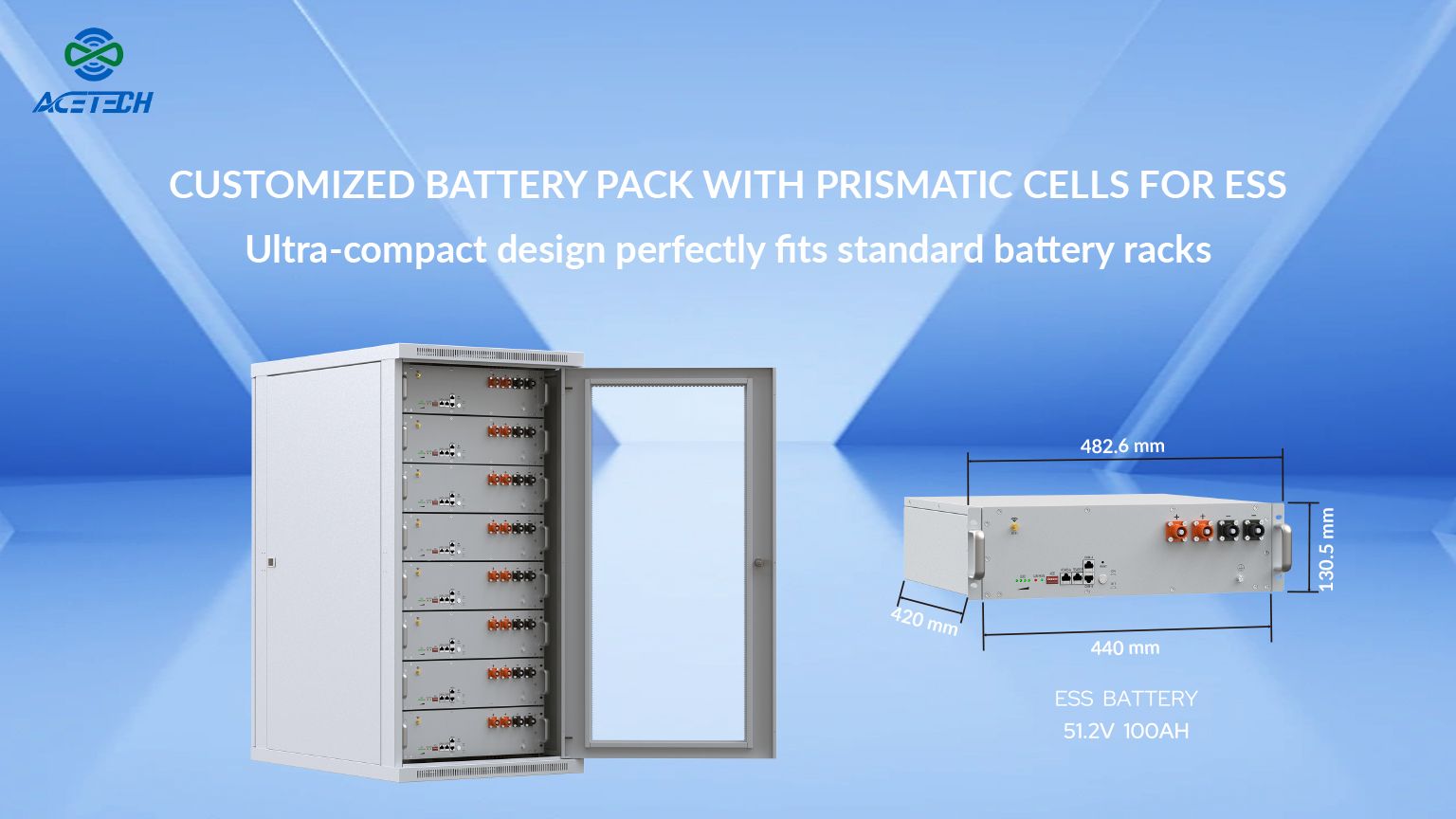
Server rack batteries are widely used in backup power, telecom power, UPS, off-grid solar systems, equipment rooms, and small commercial energy storage applications.
For ODM projects, server rack batteries are practical when the customer needs standardized modules, cabinet-based expansion, easy maintenance, and flexible system configuration. Multiple battery modules can be installed in one cabinet to increase total capacity.
The main limitation is appearance. Compared with wall-mounted and stackable batteries, server rack batteries look more industrial and are less suitable for visible residential installation areas.
Which Battery Design Is Better for Residential ESS?
For residential ESS, wall-mounted and stackable batteries are usually more suitable than server rack batteries.
Wall-mounted batteries are a good choice for entry-level and standard home energy storage products. They are compact, easy to understand, and suitable for homes, garages, villas, and utility rooms.
Stackable batteries are better for premium residential ESS. They provide flexible capacity expansion, modern appearance, and stronger private-label differentiation.
Server rack batteries can also be used in residential systems, especially for off-grid homes or equipment rooms, but they are usually more suitable for users who value function and capacity over appearance.
Wall-Mounted vs. Rack-Mounted Residential ESS: Key Technical Differences
The key technical differences between wall-mounted and rack-mounted residential energy storage systems are form factor, installation method, module capacity, expansion architecture, enclosure protection, and serviceability.
Wall-mounted ESS is generally designed for compact residential installation, with the battery enclosure mounted directly to a wall or suitable mounting structure. Depending on the model, the enclosure may also provide IP65 or IP66 protection for suitable indoor or outdoor applications. Rack-mounted ESS uses standardized battery modules installed in a rack or cabinet, making it easier to configure larger systems and expand capacity by adding modules.
The two architectures therefore serve different design priorities. Wall-mounted systems emphasize compact installation and residential integration, while rack-mounted systems prioritize modular scalability, cabinet integration, and service access. The actual capacity, IP rating, number of parallel modules, and installation requirements vary by product and manufacturer.
An ACE Battery Product Example
ACE Battery's product portfolio provides a practical example of how wall-mounted and rack-mounted battery architectures can be designed for different residential and ESS requirements. The following specifications are examples from ACE Battery's product portfolio and should not be interpreted as industry-wide standards.
| Parameter | ACE Battery Wall-Mounted ESS | ACE Battery Rack-Mounted ESS |
|---|---|---|
| Form Factor | Compact wall-mounted enclosure; selected models offer IP65/IP66 protection | Standardized rack-mounted battery module |
| Capacity Examples | 5 kWh, 6.6 kWh, and 7.6 kWh-class configurations | 5.12 kWh (51.2V 100Ah) and 14.34 kWh (51.2V 280Ah) configurations |
| Expansion | Model-dependent parallel expansion | Up to 16 modules in supported configurations |
| Installation | Wall bracket installation for homes, garages, and utility rooms | Rack or cabinet installation for dedicated technical spaces |
| Installation Requirements | Wall load capacity, mounting structure, and cable routing | Rack/cabinet assembly, module fixing, and busbar or cable connections |
| Design Priority | Compact installation and residential integration | Modular scalability, cabinet integration, and serviceability |
For example, ACE Battery's RESS-E20-H0 and selected RESS-E20-L0 configurations are designed for wall-mounted applications, with capacity configurations developed for residential energy storage. The RESS-BM-L1 provides a 5.12 kWh, 51.2V 100Ah rack-mounted battery option, while the RESS-BM-051280-L0 provides 14.34 kWh at 51.2V 280Ah for applications requiring a higher-capacity rack-mounted configuration.
In supported configurations, ACE Battery's rack-mounted battery architecture can accommodate up to 16 modules in parallel, providing greater flexibility for system capacity expansion. By comparison, wall-mounted configurations are designed around direct mounting and residential installation requirements, with expansion capability depending on the specific model.
These examples illustrate why battery form factor should be evaluated together with the overall ESS architecture. For an ODM project, factors such as target capacity, installation environment, expansion strategy, inverter compatibility, mechanical requirements, and service access should be considered before selecting a wall-mounted or rack-mounted design.
Which Battery Design Is Better for Backup Power and Small Commercial ESS?
For backup power, telecom, UPS, off-grid systems, and small commercial ESS, server rack batteries are often the most practical option.
Their modular structure makes them easy to install in cabinets, expand by capacity, and maintain over time. This is useful for engineering-focused applications where system reliability, service access, and standardized deployment are more important than residential appearance.
Stackable batteries may also be used in some light commercial scenarios, while wall-mounted batteries are more suitable for smaller-capacity applications.
Key Factors to Consider in an ESS ODM Project
When choosing between wall-mounted, stackable, and server rack batteries, ESS brands should evaluate more than the installation style. The right battery design should match the target market, capacity strategy, installation environment, system integration requirements, and private-label positioning.
Target Market and Application
Different application scenarios usually require different battery structures. For standard residential ESS, a wall-mounted battery is often suitable because it offers a compact design and clean appearance. For premium residential ESS, a stackable battery may be more attractive because it supports modular expansion and stronger product differentiation. For telecom, UPS, off-grid, or small commercial backup power, a server rack battery is often more practical due to its cabinet-based structure and easier maintenance.
Capacity and Scalability
Capacity planning is also important in ODM development. Wall-mounted batteries are suitable for standard home storage capacities, while stackable batteries are better for modular residential expansion. Server rack batteries are more suitable for cabinet-based capacity expansion, especially when multiple 48V or 51.2V battery modules need to be integrated into one system.
Installation and Mechanical Design
Each battery design has different mechanical requirements. Wall-mounted batteries require reliable brackets, proper wall load design, cable routing, and service access. Stackable batteries require stable module stacking, locking mechanisms, anti-tilt design, and safe inter-module connections. Server rack batteries require cabinet compatibility, front terminal layout, ventilation space, module fixing, and convenient maintenance access.
BMS and Inverter Compatibility
Regardless of the structure, BMS communication and inverter compatibility are critical to ESS performance. ODM development should consider CAN or RS485 communication, SOC data mapping, voltage range, charge and discharge current limits, protection logic, firmware customization, and inverter protocol adaptation. A battery design should not only fit mechanically; it must also work reliably with the target inverter ecosystem.
Safety and Thermal Management
Safety and thermal design should be considered from the beginning of the project. Wall-mounted batteries need effective heat dissipation within a compact enclosure. Stackable batteries require safe thermal management between modules. Server rack batteries need cabinet-level ventilation, cable management, and module spacing to support stable long-term operation.
Branding and Private-Label Customization
For residential ESS brands, appearance and branding are part of the product value. Wall-mounted and stackable batteries usually provide stronger visible branding opportunities through housing color, logo placement, front panel design, display interface, and packaging. Server rack batteries are more engineering-oriented, but they can still support customized front panels, product labels, manuals, packaging, and system documentation.
How to Choose the Right Battery Design
| Project Requirement | Recommended Battery Design |
|---|---|
| Standard home energy storage | Wall-mounted battery |
| Compact residential installation | Wall-mounted battery |
| Premium home ESS platform | Stackable battery |
| Flexible home capacity expansion | Stackable battery |
| High-voltage residential ESS | Stackable battery |
| 48V/51.2V backup power system | Server rack battery |
| Telecom or UPS backup | Server rack battery |
| Off-grid solar storage | Server rack or stackable battery |
| Small commercial ESS | Server rack battery |
| Strong residential branding | Wall-mounted or stackable battery |
How ACE Battery Supports Custom ESS Battery Design
ACE Battery supports customized ESS battery development for energy storage brands, solar solution providers, and private-label battery companies. Based on project requirements, ACE can assist with battery cell selection, pack design, mechanical structure, BMS communication, inverter adaptation, voltage platform configuration, safety design, enclosure customization, and private-label branding.
Whether your project requires a wall-mounted residential battery, a stackable home ESS platform, a rack-mounted LiFePO4 battery module, or a modular battery system for backup power and small commercial applications, ACE Battery can help develop a solution based on your target market, installation scenario, capacity strategy, and brand positioning.
Conclusion
There is no single best battery design for every ESS ODM project.
Wall-mounted batteries are suitable for compact and user-friendly residential ESS products. Stackable batteries are better for premium and scalable home energy storage platforms. Server rack batteries are more practical for backup power, telecom, UPS, off-grid storage, and small commercial energy storage systems.
For ESS brands, the right choice should be based on target market, capacity range, installation environment, voltage platform, BMS communication, inverter compatibility, safety requirements, and private-label product positioning.
If your company is developing a customized energy storage product, ACE Battery can support wall-mounted, stackable, rack-mounted, and modular LiFePO4 battery system development based on your application and market requirements.
FAQ
Is a wall-mounted battery better than a server rack battery?
Not always. A wall-mounted battery is usually better for residential ESS where appearance and space-saving installation are important. A server rack battery is better for cabinet-based backup power, telecom, UPS, off-grid systems, and small commercial applications.
What is the advantage of a stackable battery?
A stackable battery provides flexible capacity expansion, modern appearance, and stronger private-label differentiation. It is suitable for premium residential ESS platforms and scalable home energy storage products.
Are server rack batteries suitable for home energy storage?
Yes. Server rack batteries can be used for home energy storage, especially in off-grid homes, equipment rooms, utility rooms, or 48V/51.2V systems. However, they are usually less visually integrated than wall-mounted or stackable batteries.
Which battery design is best for private-label residential ESS?
Wall-mounted and stackable batteries are usually more suitable for private-label residential ESS because they offer better appearance, visible branding space, and stronger homeowner acceptance.
Can ACE Battery customize different ESS battery designs?
Yes. ACE Battery can support customized wall-mounted, stackable, rack-mounted, and modular LiFePO4 battery system development based on target market, capacity requirements, voltage platform, BMS communication, inverter compatibility, safety design, and branding needs.
Our expert will reach you out if you have any questions!