

Inquiry
G98 and G99 Hybrid Inverter Requirements for UK Battery Storage Systems
For many UK ESS brands, understanding G98 vs G99 is the first step before deciding whether to develop a lower-power residential solution or a higher-power battery and hybrid inverter platform. If the inverter output, battery architecture, or system documentation does not align with G98 or G99 requirements, a product that looks suitable on paper may still create problems during grid connection, installer commissioning, or market rollout.
This article explains how G98 and G99 affect hybrid inverter selection, battery storage design, and customized ESS product development for the UK market.
Why G98 and G99 Matter for UK ESS Product Development
For UK ESS brands, G98 and G99 can shape how a product line is planned before it reaches installers. A low-power residential battery system may be designed around a simpler grid connection scenario, while larger home storage or small commercial systems may require higher-power hybrid inverters and more complete technical documentation.
These requirements can influence several product decisions, including inverter output per phase, single-phase or three-phase configuration, hybrid or AC-coupled architecture, battery charge and discharge power, and installer commissioning support.
This is why UK battery storage products should be developed as an integrated battery and inverter platform, rather than as separate components selected late in the project.
G98 vs G99: The 16A per Phase Threshold
The main difference between G98 and G99 is system capacity.
G98 generally applies to fully type-tested micro-generating systems up to 16A per phase. In a typical UK single-phase system, this is often explained as approximately 3.68kW. For a three-phase system, the equivalent total capacity is often around 11.04kW, based on 3.68kW per phase.
G99 generally applies to generation and energy storage installations above 16A per phase, or systems that do not meet the G98 process requirements.
Item | G98 | G99 |
Capacity basis | Up to 16A per phase | Above 16A per phase |
Single-phase example | Up to around 3.68kW | Above around 3.68kW |
Three-phase example | Up to around 11.04kW | Above around 11.04kW |
Typical process | Install and notify | Apply before connection |
Typical ESS use | Small residential solar or hybrid inverter systems | Larger home ESS, AC-coupled batteries, small C&I systems |
For ESS product development, the key point is that G98/G99 considerations are linked to the registered AC output capacity of the generation or storage system, not the battery’s kWh capacity.
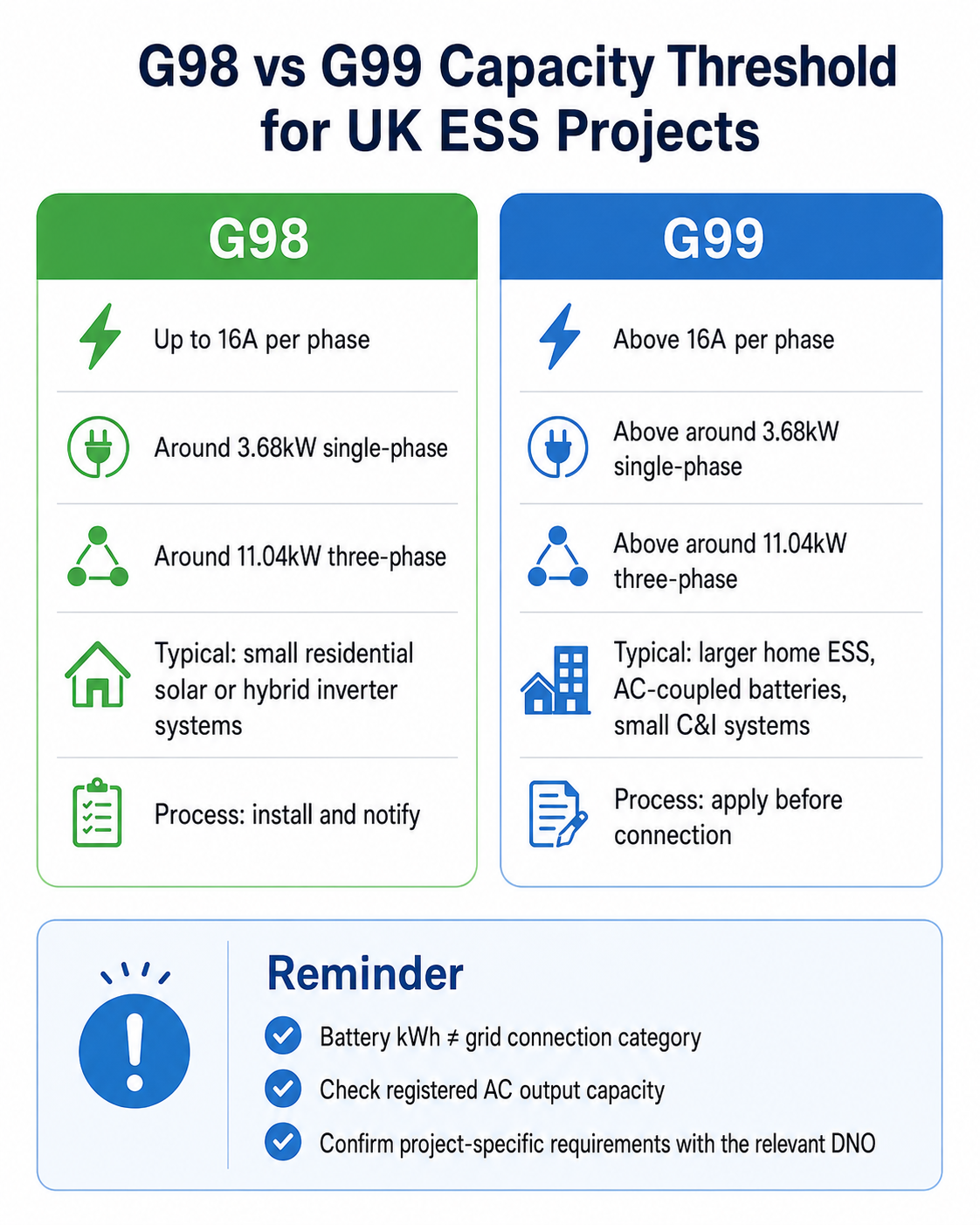
Project-specific requirements should always be confirmed with the relevant DNO, installer, or qualified grid connection professional before installation or product deployment.
Why Aggregate Capacity Matters for Solar Battery Systems
One common issue in UK solar battery system planning is looking only at a single device. In practice, G98 and G99 considerations may depend on the aggregate registered capacity at the property, including existing solar inverters, new battery inverters, and other generation equipment.
For example:
- A 3.6kW solar inverter alone may fit within a G98-type residential system.
- A 3.6kW solar inverter plus a 5kW AC-coupled battery inverter may move the system into a G99-type scenario.
- A hybrid inverter with a DC-coupled battery may be assessed differently because PV and battery power are managed through the same inverter output.
This is especially important for retrofit battery storage projects, where many homes already have solar PV installed. For ESS brands, it means system architecture should be defined early because retrofit battery products may require different inverter planning than new solar-plus-storage systems built around a single hybrid inverter.
Hybrid Inverter or AC-Coupled Battery: Why System Architecture Matters
The same battery system may be used in different UK ESS architectures, but the inverter configuration and project documentation may not be the same.
System Architecture | Why It Matters for G98/G99 |
Hybrid inverter with DC-coupled battery | PV and battery share one inverter, making the registered AC output easier to define |
AC-coupled battery system | The battery inverter may add to the property’s aggregate registered capacity |
Retrofit solar + battery system | Existing solar equipment may affect how the new battery system is planned |
For UK ESS brands, this means system architecture should be decided early. A battery platform for new solar-plus-storage installations may need different inverter settings, wiring guidance, and installer documents from a retrofit battery product.
How G98 and G99 Affect Hybrid Inverter Customization
For UK energy storage products, hybrid inverter customization should start from the target grid connection scenario, not only from appearance or branding requirements. The inverter’s AC output, phase configuration, grid-code profile, and backup function may all affect how the final ESS product is positioned for the UK market.
When developing a UK-focused hybrid inverter solution, ESS brands may need to define:
- 230V / 50Hz single-phase output
- Three-phase option if required
- AC output power per phase
- UK grid-code profile
- Type-tested inverter documentation
- EPS or backup output requirements
- Monitoring and remote firmware update needs
- Installer commissioning support
- Private-label enclosure, display, manual, and packaging
For entry-level residential battery systems, a lower-power hybrid inverter may be more suitable. For larger homes, high-consumption properties, or small commercial applications, a higher-power inverter may be required, which may bring the system closer to a G99-type project.
This is why inverter customization should be planned around the target application, expected installation scenario, and battery platform. A UK-ready ESS product should not only match the battery technically, but also support installer configuration, commissioning, and documentation needs.
How G98 and G99 Affect Battery Storage Design
Although G98 and G99 are mainly linked to inverter output and grid connection, they can also influence how the battery system is configured for the UK market.
A battery platform should be planned around the target inverter, application scenario, and expected system power. Key design factors may include:
- Battery voltage platform
- Battery capacity range
- Maximum charge and discharge power
- BMS communication with the hybrid inverter
- Protection logic and fault response
- Installation method
- Indoor, garage, or utility room installation environment
- System wiring and installation guidance
For example, an entry-level residential ESS may prioritize modular capacity, compact installation, and stable self-consumption performance. A larger home storage or small commercial system may require higher charge and discharge capability, stronger BMS coordination, and a battery platform that can support a higher-power inverter.
For UK ESS brands, this means battery design should not be separated from inverter planning. The right battery platform should support the target inverter power range, installation scenario, and product roadmap from the beginning of development.
What UK ESS Brands Should Define Before Custom Development
Before developing a customized battery and hybrid inverter solution for the UK market, ESS brands should define the system requirements clearly.
Key questions include:
- Is the target product designed for G98 or G99 applications?
- Is the system single-phase or three-phase?
- What is the maximum AC output per phase?
- Is the system based on a hybrid inverter or an AC-coupled battery inverter?
- What battery voltage platform and capacity range are required?
- Is EPS or backup power required?
- What installation environment should the product support?
- What installer and grid connection documentation is needed?
- What private-label branding, packaging, and user manuals are required?
Answering these questions early helps avoid a common development issue: building the battery product first, then discovering later that the inverter configuration, system architecture, or documentation does not fit the UK market.
How ACE Battery Supports Custom UK ESS Development
As a profesional energy storage system manufacturer, ACE Battery supports customized battery and matching hybrid inverter solution development for UK energy storage brands, solar solution providers, inverter solution providers, and private-label ESS companies.
Based on project requirements, ACE can assist with battery platform configuration, battery module and pack design, BMS communication adaptation, matching hybrid inverter customization support, enclosure design, thermal management, safety design, branding, packaging, and documentation preparation for UK market requirements.
By planning the battery and hybrid inverter together, ACE helps customers develop a more integrated ESS platform for UK residential and small commercial energy storage applications.
Need a Custom Battery and Hybrid Inverter Solution for the UK ESS Market?
ACE Battery supports customized battery platforms and matching hybrid inverter solutions for UK energy storage brands, solar solution providers, and private-label ESS companies.
Contact ACE Battery to discuss your target application, inverter power range, battery platform, system architecture, and private-label requirements.
Conclusion
G98 and G99 are not only grid connection terms. For UK ESS brands, they can influence hybrid inverter power selection, system architecture, battery platform design, and product documentation.
A UK battery storage product should be developed around the target application, inverter output, single-phase or three-phase configuration, aggregate registered capacity, battery performance, and installer requirements.
For energy storage brands developing private-label ESS products, customized battery and hybrid inverter planning can help create a more practical and market-ready solution for the UK market.
Our expert will reach you out if you have any questions!