

Inquiry
Why Custom Peak Shaving BESS Projects Fail: Design Mistakes That Reduce ROI
Many peak shaving projects fail to deliver expected ROI—not because battery storage does not work, but because systems are designed around incorrect load assumptions, poor dispatch logic, or unsuitable sizing strategies.
This article explains why peak shaving projects underperform and how sizing, EMS strategies, and customized system design may improve long-term returns.
Why Peak Shaving Projects Underperform Despite Installed Battery Storage
Businesses typically invest in peak shaving to lower demand charges and improve energy cost efficiency.
The expectation is simple:
Install storage → reduce peaks → lower electricity costs
In practice, results vary significantly.
Two facilities with similar annual electricity consumption may achieve very different financial outcomes—even with comparable battery capacities.
The difference often comes down to system design.
Common issues such as incorrect sizing, delayed EMS response, or changing load profiles can reduce savings despite technically functioning storage systems.
Common Factors Behind Underperforming Peak Shaving Projects
| Design Factor | Potential Impact on ROI |
|---|---|
| Undersized battery | Limited peak reduction and weaker savings |
| Oversized battery | Longer payback period and unused capacity |
| Delayed EMS dispatch | Missed peak events |
| Ignored tariff structure | Overestimated financial returns |
| Future load growth | Reduced system effectiveness over time |
| Fixed EMS logic | Poor adaptation to changing operations |
In many underperforming projects, battery systems work as intended. The problem is often that the design assumptions no longer match real operating conditions.
How Demand Charges and Tariff Structures Can Reduce Peak Shaving ROI
For many commercial and industrial facilities, electricity costs are influenced not only by total energy consumption but also by short periods of high power demand.
Demand charges—fees based on peak power usage—can represent a significant portion of monthly electricity bills.
This means even brief demand spikes may create disproportionately high costs.
Some utilities also apply ratchet clauses, where the highest recorded demand continues affecting future billing periods. In these cases, a single missed peak event may increase electricity costs for months rather than days.
As a result, peak shaving performance depends on more than battery capacity. Tariff structures, demand charge rules, and peak timing can all influence actual savings.
Utility Factors That Commonly Affect Peak Shaving Economics
| Utility Factor | Potential Impact on ROI |
|---|---|
| Demand charge level | Higher savings potential from peak reduction |
| Ratchet clause | Missed peaks may increase long-term costs |
| TOU pricing | Affects charging and discharge strategies |
| Seasonal tariffs | Changes savings potential over time |
| Peak frequency | Influences storage utilization and ROI |
| Load volatility | Increases dispatch complexity |
Projects designed around battery capacity alone may overestimate financial returns if utility pricing structures are not considered early in system planning.
15-Minute Load Profiles vs Battery Capacity: Why Sizing Errors Reduce ROI
One of the most common mistakes in BESS design is sizing storage systems primarily around average electricity consumption.
However, average demand rarely determines peak shaving performance.
What matters more is how long peaks last and how frequently they occur.
Consider two facilities:
| Facility | Peak Demand | Peak Duration |
|---|---|---|
| Facility A | 500 kW | 15 min |
| Facility B | 500 kW | 2 hours |
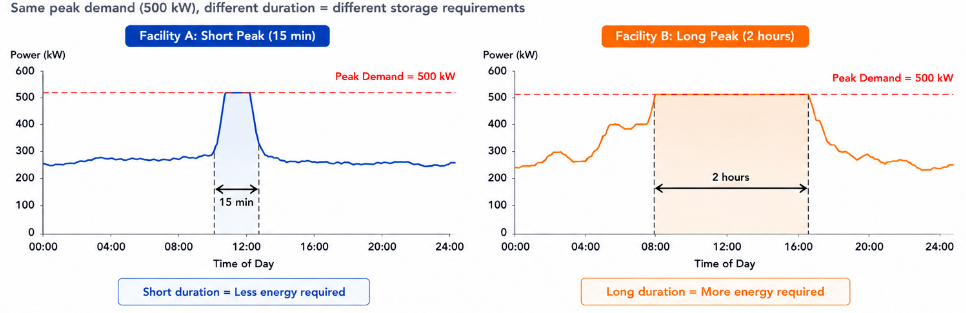
Although both facilities reach the same peak demand, their storage requirements differ substantially.
A system designed only around maximum power may perform adequately in Facility A while failing to sustain discharge long enough for Facility B.
This is why interval load data—typically 15-minute profiles or shorter—is often used to evaluate:
- Peak duration
- Frequency of occurrence
- Load variability
- Seasonal changes
- Future expansion requirements
Sizing decisions based only on average consumption can lead to inaccurate ROI expectations.
Why Peak Duration Matters More Than Average Consumption
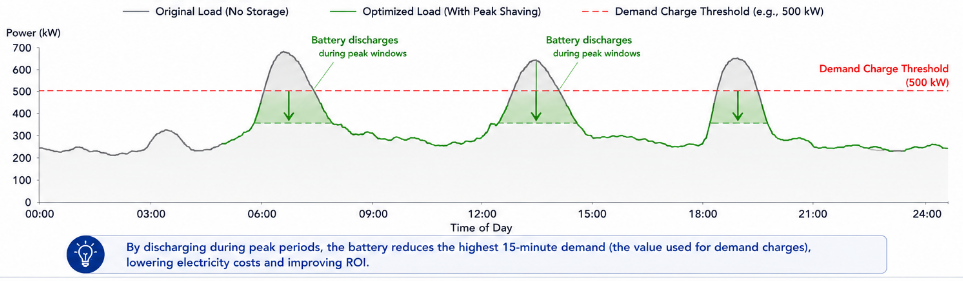
The simplified example below illustrates how optimized dispatch can reduce short-duration spikes.
The objective is not always eliminating peaks entirely. In many projects, lowering the highest demand window may already improve savings significantly.
Peak shaving concept illustration:
In practical applications:
- Original load curve: short periods of high demand create elevated demand charges.
- Optimized dispatch: stored energy is released during peak windows to reduce maximum recorded demand.
Even relatively small reductions may improve project economics under demand-charge-heavy tariff structures.
Typical Outcomes of Incorrect BESS Sizing
| Sizing Issue | Typical Impact on Performance & ROI |
|---|---|
| Undersized system | Battery depletes before peaks end, limiting savings potential |
| Oversized system | Higher investment cost and underutilized capacity |
| Poor load assumptions | Lower sizing accuracy and weaker financial outcomes |
| Ignoring future expansion | Earlier upgrade pressure and reduced long-term flexibility |
Correct sizing is more than an engineering decision.
It influences storage utilization, project payback, and long-term investment efficiency.
How EMS Strategy Influences Peak Shaving Performance and ROI
Peak shaving success depends not only on available battery capacity but also on when stored energy is discharged.
A battery may contain sufficient energy and still fail to reduce demand charges if dispatch timing is inaccurate.
Common EMS-related issues include:
- Fixed schedules that no longer match actual load behavior
- Delayed response to sudden demand spikes
- Poor load forecasting
- Communication delays among EMS, PCS, and battery systems
Modern EMS strategies increasingly use real-time monitoring, historical consumption patterns, tariff signals, and load forecasting to improve dispatch decisions.
Rather than reacting after peaks occur, adaptive control logic aims to anticipate demand. Adaptive EMS strategies may improve dispatch accuracy, battery utilization, and long-term savings.
For facilities with highly variable loads, optimizing EMS strategies may improve peak shaving performance more effectively than simply increasing battery capacity.
Evaluating Peak Shaving ROI: Beyond Electricity Savings
Peak shaving ROI is often estimated using expected reductions in demand charges.
However, project economics typically depend on multiple factors beyond electricity savings alone, including:
- Demand charge reduction potential
- Battery utilization and degradation
- Maintenance costs
- EMS performance
- Future expansion requirements
- Utility tariff structures
A simplified ROI estimate may be expressed as:
ROI=(Annual Savings−Operating Costs)/Total System Investment
In practice, projects with similar battery capacities may achieve very different returns because operating conditions, dispatch strategies, and tariff mechanisms vary substantially.
This is one reason standardized ROI assumptions frequently underestimate or overestimate actual project performance.
Why Customized BESS Design Improves Peak Shaving Performance and Long-Term ROI
Standardized energy storage systems may perform well under stable operating conditions.
However, many commercial and industrial facilities experience changing load behavior, evolving energy objectives, and future expansion requirements over time.
As operational complexity increases, fixed system configurations may become less effective.
Different Applications Often Require Different Priorities
| Application | Typical Load Characteristic | Design Priority |
|---|---|---|
| Manufacturing | Sustained peaks | Runtime & scalability |
| EV charging | Short-duration spikes | Fast response |
| Data center | Rapid fluctuations | Dispatch speed & reliability |
The same storage configuration may not produce identical performance—or ROI—across these scenarios.
Customized system design often focuses on improving how storage behaves under real operating conditions rather than simply increasing installed capacity.
Potential optimization areas include:
Adaptive EMS and Dispatch Strategies
Peak shaving performance depends not only on available battery capacity but also on when energy is discharged.
Dynamic EMS approaches increasingly combine historical load patterns, real-time monitoring, and forecasting to improve dispatch timing.
Different facilities may prioritize different outcomes, such as lowering demand charges, preserving battery lifespan, or supporting renewable integration.
As a result, control strategies often need to vary by application.
Integration Compatibility Across Energy Systems
Peak shaving performance increasingly depends on coordination among:
EMS → PCS → BMS → SCADA → Solar → Backup systems
Communication compatibility affects responsiveness and overall efficiency.
Integration complexity generally increases with project scale.
Modular Architecture for Future Expansion
Energy demand often changes over time due to production growth, additional EV chargers, or expanding facilities.
Modular architectures may support:
✓ Incremental capacity expansion
✓ Lower upgrade costs
✓ Greater long-term flexibility
This approach can reduce oversizing risk while improving lifecycle utilization.
Thermal management requirements may also vary depending on cycling frequency and application type.
For facilities with variable loads or long-term expansion plans, customized system design may improve both peak shaving performance and investment predictability.
When Should Businesses Consider a Custom Peak Shaving BESS Evaluation?
Not all peak shaving projects require tailored system design.
However, deeper evaluation often becomes more valuable when facilities experience:
- Persistent demand charge pressure despite existing optimization efforts
- Rapid load growth, such as equipment expansion or additional EV charging capacity
- Multiple energy objectives, including peak shaving, backup power, and renewable integration
- Long-term expansion plans that may exceed initial system assumptions
As operating complexity increases, standardized configurations may become less effective over time.
What Information Helps Improve Custom BESS Evaluation Accuracy?
Projects often underperform because system design begins with incomplete operating data.
Preparing the following information may improve sizing accuracy and ROI estimates:
- Electricity bills (preferably 12 months)
Used to evaluate demand charges, tariff structures, and seasonal trends.
- Load profile data (15-minute intervals or shorter)
Supports peak identification, sizing analysis, and dispatch planning.
- Future expansion expectations
Examples include production growth, additional EV chargers, or facility upgrades.
- Existing energy assets and project objectives
Such as solar PV, backup systems, resilience goals, or renewable integration priorities.
Projects built around clearer inputs often achieve more predictable outcomes.
Conclusion: Better Peak Shaving ROI Starts with Better System Design
Many peak shaving projects underperform not because battery storage fails, but because systems are designed around incomplete assumptions about load behavior, tariff structures, or future demand.
Achieving predictable ROI often depends on how accurately storage capacity, EMS strategies, dispatch logic, and expansion requirements match real operating conditions.
For facilities facing frequent demand spikes, growing energy needs, or multiple energy objectives, early evaluation may help reduce oversizing risk and improve long-term returns.
If you are assessing a peak shaving project, preparing load profiles, electricity bills, and future expansion plans is often the first step toward more accurate BESS design and ROI estimation.
ACE Battery supports customized energy storage solutions designed around actual application requirements, including EMS strategies, modular architectures, and complex integration scenarios for commercial and industrial projects.
Need to determine whether your current load profile supports profitable peak shaving?
Discuss your operating conditions, demand patterns, and future expansion plans with ACE Battery to evaluate whether a standard system—or a customized approach—fits your project.
Our expert will reach you out if you have any questions!