

A Battery Energy Storage System (BESS) depends on reliable communication between its battery management system (BMS), power conversion system (PCS), and energy management system (EMS). These components exchange battery operating data, power limits, alarms, and control information to coordinate charging, discharging, and energy distribution.
However, different devices may use different communication protocols and data structures. Even when two devices support the same communication interface, differences in register mapping, message definitions, or firmware can prevent them from working together correctly.
Modbus, MQTT, and APIs are three common communication options in industrial and energy management applications. Modbus is widely used for industrial device communication, MQTT supports distributed data exchange and remote monitoring, and APIs connect software applications and management platforms.
Understanding how these interfaces work, where they fit into a BESS architecture, and how to validate compatibility is essential for system integrators and battery OEMs.
Understanding Communication Interfaces in a BESS
A BESS requires different types of communication at the battery, equipment control, and energy management levels. The communication architecture determines how operating information moves between these components and how control decisions are coordinated.
How BMS, PCS, and EMS Communicate
Three major components form the foundation of most BESS communication architectures:
- Battery Management System (BMS): Monitors cell and pack voltage, current, temperature, state of charge (SOC), and state of health (SOH). It also manages battery protection and provides charging and discharging limits.
- Power Conversion System (PCS): Converts power between the battery's DC side and the AC grid or connected loads. It controls charging and discharging according to system requirements.
- Energy Management System (EMS): Coordinates energy distribution, monitors system performance, and manages operating strategies based on load demand, electricity prices, and grid conditions.
These components exchange information to keep the energy storage system operating within defined limits.
For example, the BMS can communicate the battery's maximum allowable charging and discharging current to the PCS. The PCS uses this information to regulate power conversion, while the EMS coordinates the system according to its operating strategy.
The actual communication topology varies by project. The BMS may communicate directly with the PCS and EMS, or a battery controller or communication gateway may collect and distribute information.
What Data Needs to Be Exchanged?
The communication requirements depend on the BESS configuration and control strategy. Common data points include:
- Battery voltage and current
- State of Charge (SOC) and State of Health (SOH)
- Cell and module temperatures
- Maximum charging and discharging current
- Battery operating limits
- Alarm and fault information
- PCS operating status and power information
- EMS scheduling and control commands
Different data types have different communication requirements. Battery protection must operate locally, while operating data may be transmitted to an EMS or remote monitoring platform at regular intervals.
Key consideration: A protocol suitable for remote monitoring is not automatically suitable for device-level control or safety-related functions.
Modbus vs MQTT vs API: Key Differences
Modbus, MQTT, and APIs support different communication models. They should be evaluated according to the equipment being connected and the type of information being exchanged.
Modbus: Industrial Communication for Device-Level Integration
Modbus is an industrial communication protocol widely used in automation, monitoring, and control equipment.
Its two common implementations are:
- Modbus RTU: Typically operates over serial communication interfaces such as RS-485.
- Modbus TCP: Uses TCP/IP networks, commonly over Ethernet.
Modbus uses a client-server request-response model. A client requests data from a server, which responds with register values or processes supported commands.
In a BESS, Modbus may be used for communication between a BMS, PCS, local EMS, or other industrial equipment, depending on their supported interfaces and protocol configurations.
Advantages:
- Widely supported in industrial automation equipment.
- Suitable for local device-level communication.
- Uses structured registers for data access.
- Relatively straightforward to implement in many industrial control environments.
Limitations:
- Requires accurate register mapping between connected devices.
- Polling intervals and device response times need to be configured.
- The basic protocol does not provide comprehensive authentication or encryption.
- Different manufacturers may define different register addresses, data formats, and command structures.
For battery OEMs, Modbus support alone does not guarantee compatibility with a particular PCS. Both devices must interpret the same data definitions and control parameters.
How Does CAN Differ from Modbus in Battery Communication?
CAN is another common communication option for BMS-to-inverter and BMS-to-PCS integration. Unlike Modbus RTU, which uses a request-response model based on registers, CAN typically exchanges information through message identifiers and predefined data frames.
The two approaches have different implementation requirements:
- CAN communication depends on message IDs, data frame definitions, and signal scaling.
- Modbus communication depends on register addresses, function codes, data types, and scaling factors.
The choice between CAN and Modbus depends on the target equipment's supported interfaces, communication requirements, and data definitions. Neither automatically guarantees compatibility with a particular inverter or PCS.
MQTT: Lightweight Messaging for Remote Monitoring
MQTT (Message Queuing Telemetry Transport) is a lightweight messaging protocol designed for communication between connected devices and applications.
It uses a publish/subscribe model. Devices publish messages to specific topics through an MQTT broker, while subscribed applications receive the relevant information.
For example, a BESS controller can publish battery SOC, temperature, power, and alarm information to an MQTT broker. A cloud-based monitoring platform can subscribe to these topics to collect operating data from multiple storage sites.
Advantages:
- Lightweight messaging with relatively low communication overhead.
- Suitable for distributed energy systems and remote monitoring.
- Publish/subscribe architecture reduces direct dependencies between devices.
- Supports different Quality of Service (QoS) levels for message delivery.
Limitations:
- Requires an MQTT broker and a defined topic structure.
- Network interruptions require reconnection and message-handling strategies.
- QoS does not guarantee deterministic real-time control.
- Authentication, TLS encryption, and access permissions must be configured for secure communication.
MQTT is particularly useful for telemetry and remote supervision. In many BESS architectures, an EMS or communication gateway handles MQTT communication rather than the battery BMS directly.
API: Software-Level Integration Between Energy Platforms
An Application Programming Interface (API) defines how software applications exchange information or request services.
In BESS applications, APIs commonly connect energy management platforms with third-party software, monitoring dashboards, customer systems, and enterprise applications.
Two common implementation approaches are:
- REST API: Uses HTTP methods such as GET and POST to retrieve information or submit application-level requests.
- WebSocket API: Maintains a persistent connection that supports bidirectional communication between applications.
For example, a third-party energy management platform may use a REST API to retrieve battery performance reports or submit an energy scheduling request to a cloud-based BESS management platform.
Advantages:
- Flexible integration between software platforms.
- Clearly defined data structures and application functions.
- Convenient access to monitoring, reporting, and management services.
- Supports third-party application development.
Limitations:
- Requires API documentation and defined request and response formats.
- Authentication and access permissions must be managed.
- Request frequency and rate limits may affect performance.
- Standard REST request-response interactions are not necessarily suitable for high-frequency equipment control.
API is a broad software interface concept rather than a single communication protocol. REST and WebSocket are two approaches to implementing APIs.
Modbus vs MQTT vs API: A Comparison
| Comparison | Modbus | MQTT | API |
|---|---|---|---|
| Communication model | Request-response | Publish/subscribe | Request-response or persistent connection |
| Typical environment | Industrial networks | IoT and cloud networks | Software platforms |
| Main application | Device-level communication | Remote monitoring and telemetry | Platform integration |
| Data exchange | Registers and function codes | Messages and topics | Structured requests and responses |
| Common implementations | RTU, TCP | MQTT over TCP/IP | REST, WebSocket |
| Key consideration | Register mapping | Broker, topics, and QoS | Authentication and API design |
The three options are not necessarily alternatives. A BESS can use Modbus for local equipment communication, MQTT for remote monitoring, and APIs for external software integration.
How to Choose the Right Interface for BESS Integration
The appropriate communication interface depends on the BESS architecture, connected equipment, data requirements, and control responsibilities.
Rather than selecting one protocol for the entire system, evaluate each communication link separately.
1. Match the Interface to the Network Architecture
Different communication environments call for different interfaces.
- Local industrial equipment: Modbus RTU, Modbus TCP, or CAN may be appropriate for communication between battery systems, PCS equipment, and local controllers, depending on equipment compatibility.
- Remote monitoring: MQTT is suitable for transmitting operating data across distributed sites or to cloud-based platforms.
- Software integration: APIs are useful when connecting a BESS management platform to external applications, reporting systems, or customer software.
The physical network also matters. For example, Modbus RTU over RS-485 and Modbus TCP over Ethernet have different wiring, network, and configuration requirements.
2. Evaluate Data Frequency and Response Requirements
Not all BESS data needs to be transmitted at the same frequency.
Battery voltage, current, and temperature may require regular monitoring. Alarm information should be communicated reliably, while EMS scheduling commands need clearly defined execution and confirmation procedures.
When selecting an interface, consider:
- Required data update frequency
- Communication latency and response behavior
- Number of connected devices
- Network stability and interruption handling
- Command acknowledgment and error handling
Safety requirement: Battery protection functions must remain independent of cloud connectivity. MQTT or API availability should never be the sole basis for essential BMS safety decisions.
3. Check BMS, PCS, and EMS Compatibility
Protocol compatibility is one of the most important factors in BESS integration.
Two devices may both support CAN, RS-485, or Modbus, yet still fail to exchange information correctly.
Compatibility depends on several technical details:
- Physical communication interface
- Communication baud rate and network settings
- Protocol version and message structure
- Register addresses and data mapping
- Data types, units, and scaling factors
- SOC and operating-limit definitions
- Alarm codes and fault-state mapping
- Read/write permissions and command logic
- Firmware version compatibility
For example, a PCS may require battery SOC, maximum charging current, maximum discharging current, and fault information from the BMS. If these values are transmitted using different register definitions or interpreted incorrectly, the system may display inaccurate battery information or fail to coordinate charging and discharging properly.
For more details, see ACE Battery's guide to BMS Communication with Solar Inverters: CAN, RS485, and Battery Compatibility.
How Modbus, MQTT, and APIs Work Together in a Commercial BESS
In many commercial energy storage projects, using multiple communication interfaces is more practical than relying on one protocol for every connection.
Consider a commercial BESS consisting of a lithium battery system, BMS, PCS, local EMS, and cloud monitoring platform.
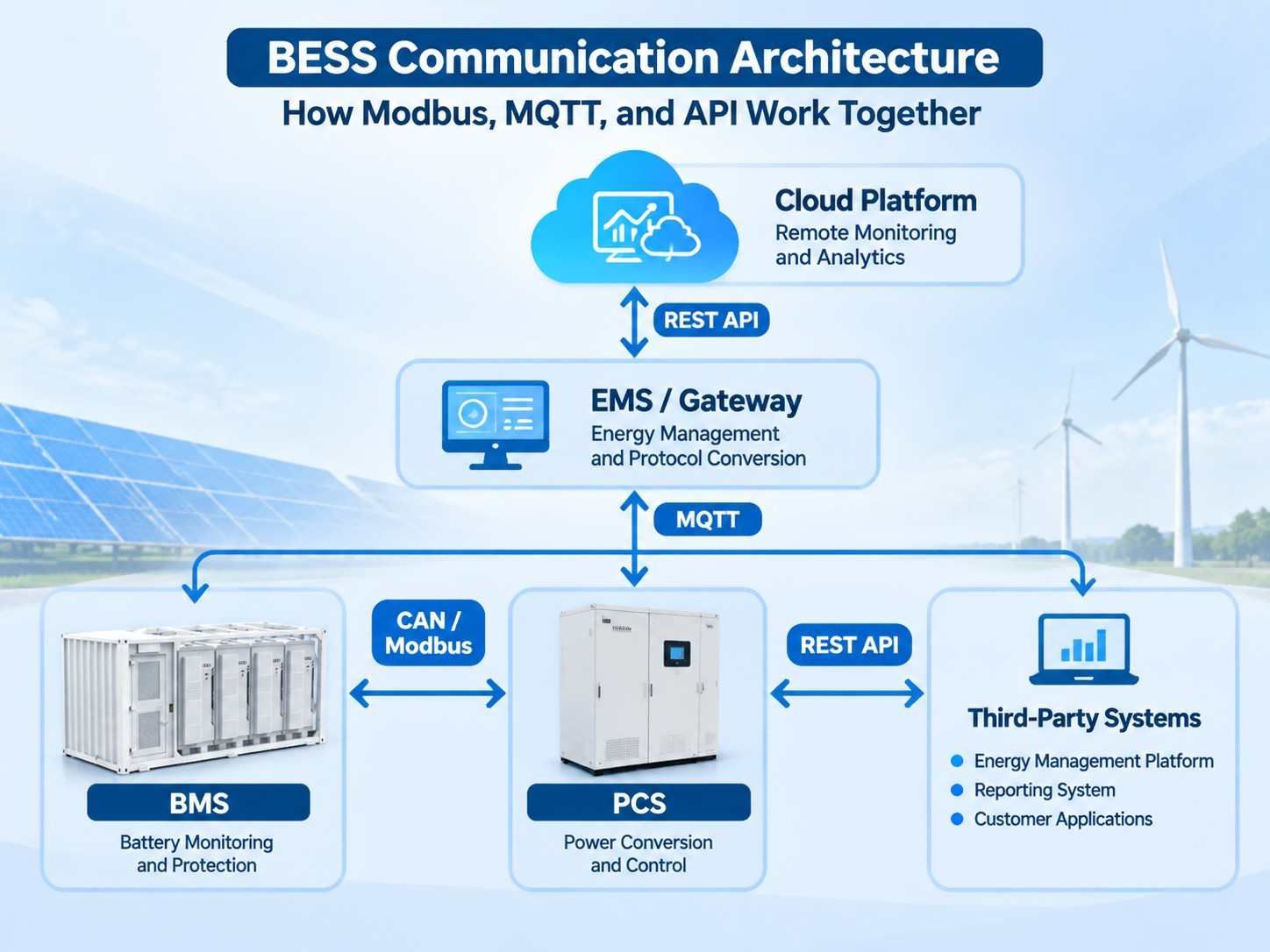
Example: A Multi-Protocol BESS Architecture
A typical communication arrangement could look like this:
Commercial BESS Communication Architecture
Battery status, SOC, alarms, and operating limits
Power conversion and charging/discharging control
Data collection and energy management
Remote monitoring and performance analysis
External applications and reporting systems
*The actual BMS-to-PCS interface depends on the supported hardware, protocol, and project configuration. The diagram illustrates one possible arrangement, not a mandatory architecture.
The communication responsibilities can be divided into three layers.
1. BMS and PCS: Local Equipment Communication
The BMS exchanges battery status and operating limits with the PCS through a supported industrial communication interface. Depending on the equipment, this may use CAN, RS-485 with Modbus RTU, or Modbus TCP over Ethernet.
The PCS uses the received information to coordinate battery charging and discharging within the permitted operating range.
2. EMS and Cloud Platform: Remote Data Transmission
The local EMS or communication gateway collects operating information from the BMS and PCS. It can publish selected data through MQTT for remote monitoring, performance analysis, and centralized management.
The gateway or EMS handles the communication conversion when the battery itself does not directly support MQTT.
3. Cloud Platform and Third-Party Software: Application Integration
REST APIs allow external applications to retrieve reports, access operational data, or exchange supported management requests with the BESS platform.
This arrangement separates local equipment communication from remote monitoring and software integration.
Why a Multi-Protocol Approach Can Be More Practical
Using different interfaces for different communication tasks can provide several advantages:
- Functional separation: Local equipment communication and cloud-based monitoring operate through appropriate interfaces.
- Integration flexibility: Equipment from different manufacturers can connect through supported protocols and gateways.
- Easier platform expansion: Additional monitoring and management applications can access data without connecting directly to every battery.
- Scalable architecture: The communication structure can accommodate additional storage units, sites, or external platforms.
However, a multi-protocol architecture also requires consistent data definitions, secure network configuration, and clearly defined control responsibilities.
What Battery OEMs Should Consider Before BESS Integration
For battery OEMs and BESS system integrators, communication requirements should be defined during battery specification and product development.
A battery may meet the required voltage, capacity, and power specifications but still need BMS configuration or communication adaptation to work with the target PCS and EMS.
Define Communication Requirements Before Battery Development
Consider an OEM developing a lithium battery platform for a specific commercial inverter or PCS.
Before finalizing the battery design, the OEM should provide or confirm:
- Target inverter and PCS models
- Battery voltage range and maximum charging/discharging current
- Required communication interfaces and protocols
- BMS data points and register or CAN message definitions
- SOC, alarm, and protection status requirements
- Firmware and communication version requirements
- EMS monitoring and control requirements
These details should be included in the initial battery specification rather than left until system commissioning.
For a more detailed specification process, see How to Specify a Custom Battery for a Solar PV Energy Storage System.
How Custom BMS Development Supports OEM Integration
When standard battery configurations do not meet the communication requirements of the target system, custom BMS development or protocol adaptation may be necessary.
Depending on project requirements and hardware capabilities, the battery supplier may need to:
- Select or configure supported communication interfaces.
- Adapt CAN message definitions or Modbus register mappings.
- Configure battery status, alarm, and protection data.
- Match charging and discharging parameters with the target PCS.
- Integrate communication functions with the battery controller or gateway.
- Test data exchange and control behavior with the target equipment.
For example, an OEM may require a battery to communicate with a particular PCS using specific SOC definitions, charging limits, and alarm codes. The BMS communication configuration must be aligned with the PCS requirements and validated using the actual equipment.
ACE Battery provides customized lithium battery development for OEM and ODM applications. Its published technical materials describe CAN/RS485 communication support, inverter communication adaptation, and BMS data mapping for relevant battery projects.
The required interfaces and customization scope should be confirmed for each battery configuration and target equipment. MQTT or API integration may also require an external controller, gateway, or EMS rather than direct BMS support.
For more information, explore ACE Battery's Custom Battery Development and Integration Solutions.
Validate Communication Before Deployment
Protocol support alone does not guarantee successful integration. Before mass production or BESS deployment, the battery and connected equipment should undergo communication and functional validation.
Important checks include:
| Validation Item | What to Verify |
|---|---|
| Communication connection | Correct wiring, interface, and network settings |
| Data mapping | Accurate SOC, voltage, current, and temperature values |
| Operating limits | Correct charging and discharging limit transmission |
| Alarm handling | Accurate fault and protection status reporting |
| Command handling | Correct command permissions and response behavior |
| Firmware compatibility | Consistent protocol and firmware versions |
| Network recovery | Appropriate behavior after communication interruptions |
For OEM projects, an inverter compatibility matrix can also help record tested equipment models, firmware versions, supported protocols, configuration requirements, and validation results.
This provides a clearer basis for product release, installation documentation, and after-sales support.
Conclusion: Choose the Interface Based on Your BESS Architecture
Modbus, MQTT, and APIs serve different roles in battery energy storage integration.
Modbus is commonly used for industrial device-level communication, MQTT supports distributed data transmission and remote monitoring, and APIs connect software applications and energy management platforms. CAN is another important option for battery-level communication, particularly in BMS-to-inverter integration.
For many commercial and industrial BESS projects, combining these interfaces provides a practical way to connect battery equipment, coordinate local energy management, and integrate remote monitoring systems.
For battery OEMs, however, selecting the right interface is only part of the integration process. BMS data mapping, PCS compatibility, charging and discharging limits, firmware configuration, and system-level testing are equally important.
ACE Battery supports customized lithium battery and OEM/ODM development requirements, including project-specific communication and inverter integration assessment.
Developing a Custom Battery System for Your BESS Application?
Discuss your battery specifications, communication requirements, and OEM/ODM integration needs with ACE Battery.
Contact ACE Battery