

Inquiry
Mastering Dynamic Loads in the AI Era: How ACE Ensures Uncompromised BBU Power Reliability for Data Centers
Executive Summary
As AI workloads and high-density computing drive data center power demands to unprecedented heights, dynamic load fluctuations have emerged as a primary threat to power grid stability. This paper explores the unique technical challenges dynamic loads present to Battery Backup Units (BBUs) and demonstrates how ACE leverages cell-level co-development, advanced dynamic modeling, proprietary database matching, and full-stack hardware verification to deliver robust, custom-tailored BBU solutions.
I. Understanding Dynamic Loads in Modern Data Centers
In modern data center power supply architecture, load profiles are rarely steady-state lines; they are complex, rapidly fluctuating curves. Dynamic load refers to the rapid and large-scale shifts in power demand caused by sudden computational bursts, task scheduling, hardware state transitions, and server start-up or shutdown sequences.
Taking an AI training server as a primary example, when a GPU cluster instantly jumps from an idle state to full-load tensor processing, total power demand can surge from hundreds of watts to thousands of kilowatts within milliseconds. Conversely, when task queue switching or computing load shedding occurs, power consumption plummets just as rapidly. This pulsating, wide-amplitude, and fast-transient behavior defines the dynamic load characteristic.
Unlike traditional steady-state loads, dynamic loads impose extremely stringent requirements on power infrastructure:
- Instantaneous Power Output: The system must deliver massive peak currents on demand without voltage collapse.
- Transient Stability: Output voltage must remain stable under severe transient operating conditions, including deep voltage sags, high-current spikes, and high-frequency charge-discharge switching.
- Risk Mitigation: Any latency or degradation in transient response can result in system voltage drops, server resets, silent data corruption, or catastrophic hardware failure.
II. Four Key Dimensions of Dynamic Loads in BBU Applications
As the critical "last line of defense" in the data center power chain, the Battery Backup Unit (BBU) manages the vital millisecond-to-minute transition between a utility grid outage and the full activation of secondary backup sources (such as uninterruptible power supplies and diesel generators). In dynamic load scenarios, BBU performance relies on four key engineering dimensions:
1. Ultra-Fast Transient Power Response
Upon grid loss, the BBU must instantaneously assume the total system power load. The rate at which power output ramps from zero to full load directly determines whether backend hardware achieves a true "seamless transition." Transient voltage sag depth and recovery time serve as the primary metrics for evaluating a BBU's dynamic response capability.
2. High-Rate Discharge & Cell Plateau Behavior
As peak power densities of modern rack architectures escalate, BBU battery cells are routinely required to operate at discharge rates far exceeding standard nominal parameters. Under high-rate pulsed discharge, a cell's voltage plateau, thermal dissipation behavior, and usable capacity retention deviate significantly from standard spec sheets. This divergence is the root cause of solutions that appear promising on datasheets but fail under real-world stress.
3. Dynamic Runtime Calibration
Backup duration (runtime) is a core design SLA for data centers, yet calculating runtime under dynamic load is far more complex than applying static formulas like:
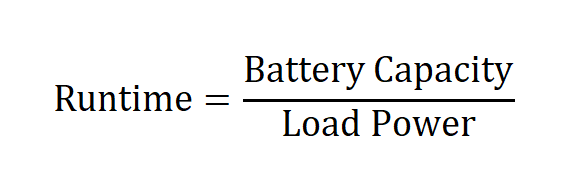
Pulse profiles, duty cycles, peak-to-average power ratios (PAPR), and temperature transients heavily alter the battery cell's effective discharge depth and dynamic internal resistance. Precise runtime commitments demand high-resolution simulation combined with empirical dynamic load testing.
4. Micro-Cycle & Operating Condition Adaptability
Dynamic server workloads mean that the BBU is frequently exposed to micro-charge/discharge cycles, shallow state-of-charge (SoC) fluctuations, and continuous thermal shifts. This operational regime requires exceptional cell consistency, superior micro-cycle life, and dynamic thermal management—exceeding the requirements of standard static backup power applications.
III. ACE’s Full-Stack Engineering Capabilities: From Cell to System
As a specialized provider of turnkey BMS and BBU system solutions, ACE addresses the challenges of dynamic loads and runtime through a disciplined "Requirements → Cell Co-Design → Simulation → Verification" methodology:
- Deep Application & Market Insight: ACE engages directly with cloud service hyperscalers and AI center architects to translate diverse operational demands—from minute-level backup in cloud datacenters to second-level high-rate pulse support in AI clusters—into exact engineering requirements.
- Cell-Level Co-Development: Peak dynamic performance starts at the chemistry level. ACE collaborates with leading battery cell manufacturers across material selection, electrode architecture, electrolyte formulation, and structural design. This ensures cells are engineered for high rate capabilities, fast response, and extended cycle life from the ground up, rather than relying on off-the-shelf commodity cells.
- Proprietary Simulation & Database Matching: ACE maintains a dynamic load cell database and system simulation platform. When presented with complex, customer-specific load profiles, ACE engineers run predictive models to rapidly match the optimal cell formulation and project overall thermal and electrical performance, dramatically cutting development cycles.
- Comprehensive Module-Level Verification: Beyond virtual simulation, ACE validates designs using hardware-in-the-loop (HIL) and physical module testing. Empirical calibration ensures that performance specifications, runtime metrics, and transient response guarantees are fully verifiable and field-ready.
IV. Concrete Value Delivered to Customers
| Value Pillar | Customer Outcome |
Accelerated Time-to-Market | Pre-validated cell portfolios and dynamic load domain expertise eliminate costly design trial-and-error, shortening product delivery cycles. |
| Precision Performance Commitments | Dual-driven by "Simulation + Physical Calibration," ACE provides SLA guarantees for runtime, transient response, and cycle life, lowering operational risks. |
| Optimized Total System Cost (TCO) | Precise selection avoids over-engineering (excessive cost/weight) and under-engineering (downtime risk), yielding an optimal balance between cell cost, BMS complexity, and footprint. |
| Differentiated Competitive Moat | Joint chemistry-level development ensures BBU designs break free from standard off-the-shelf limits, securing a clear technological advantage. |
V. Conclusion
As data center power density continues to climb and AI workloads introduce unprecedented electrical volatility, BBU engineering has evolved from simple "battery plus protection board" assembly into a precise science of dynamic load management. ACE remains committed to providing industry partners with deep technical expertise, robust cell-to-system engineering, and uncompromised power reliability for next-generation data centers.
Our expert will reach you out if you have any questions!