

Inquiry
Liquid Cooling vs Air Cooling in Battery Energy Storage Systems: A Decision Guide for BESS Projects
For most modern battery energy storage systems (BESS), the choice between liquid cooling and air cooling ultimately depends on how you prioritize performance, lifecycle, and cost.
In general, liquid cooling is better suited for high-density and high-performance applications where long-term reliability and return on investment matter most. Air cooling, on the other hand, remains a practical option for smaller systems with tighter budgets and lower operational demands.
A simple way to think about it is this: if your project is designed for long-term operation with high utilization, liquid cooling is usually the more effective solution. If the focus is on minimizing upfront cost and system complexity, air cooling can still meet the requirement.
Why Battery Cooling Matters More Than Ever in Modern BESS
Battery thermal management has become a central design factor in modern energy storage systems. As battery cells continue to evolve toward higher capacities—particularly with the widespread adoption of 280Ah and 314Ah LFP cells—heat generation within the system increases significantly.
At the same time, many commercial and industrial applications require higher charge and discharge rates, which further intensify thermal stress. Under these conditions, cooling is no longer just about preventing overheating. It directly influences efficiency, safety, and long-term system stability.
In real-world projects, insufficient thermal management often leads to accelerated degradation, reduced usable capacity, and increased safety risks. For this reason, cooling design is now considered a core part of BESS engineering rather than an auxiliary feature.
How Temperature Difference Affects Battery Lifespan in BESS
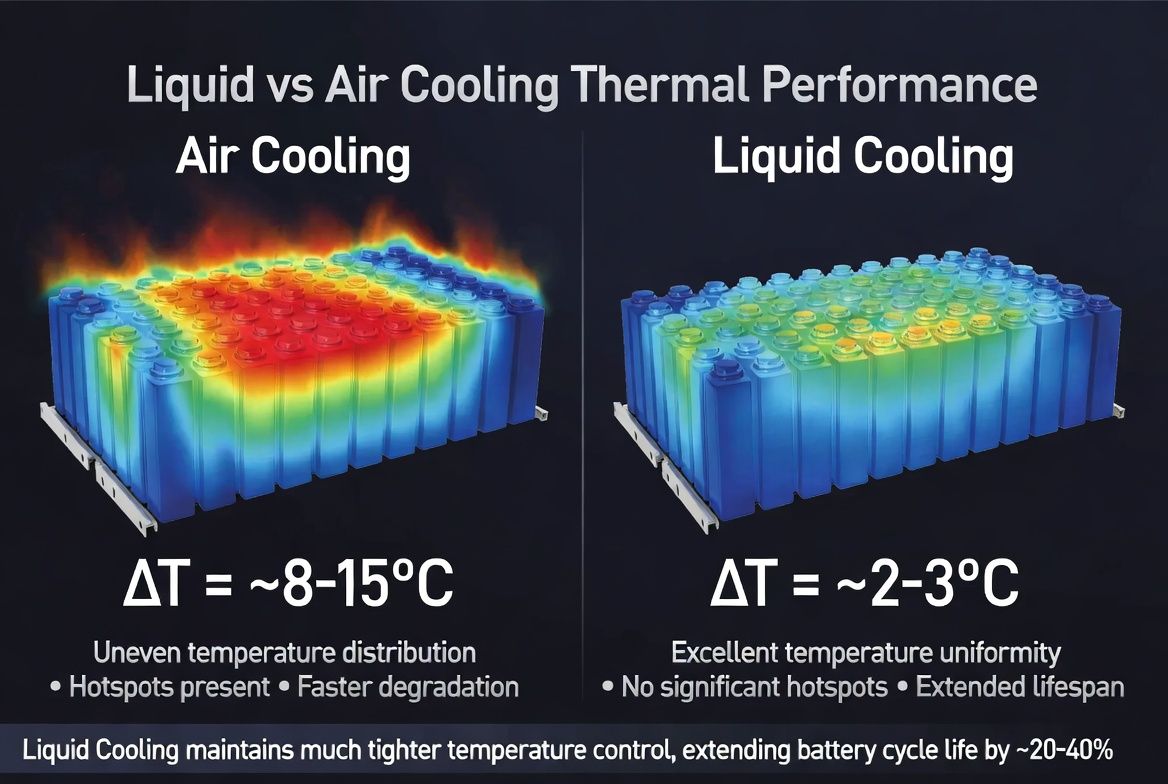
When evaluating cooling strategies, many people focus on average temperature. However, what truly determines long-term performance is the temperature difference between cells inside the system.
In well-designed liquid-cooled systems, temperature variation can typically be controlled within ±2–3°C. In contrast, air-cooled systems often experience variations in the range of ±8–15°C, especially under high load or in warm environments.
Although these differences may appear moderate, their long-term impact is significant. Cells operating at higher temperatures degrade faster than those in cooler conditions, which leads to imbalance across the battery pack. Over time, this imbalance reduces overall system efficiency and shortens usable lifespan.
Maintaining a stable and consistent battery operating temperature range is therefore critical for preserving performance and extending battery life.
More uniform temperature control helps maintain consistency across cells. In many practical deployments, liquid cooling can extend battery lifespan by approximately 20–40% compared to air-cooled configurations. This is one of the key reasons why liquid cooling is increasingly adopted in large-scale and high-utilization BESS projects.
How Air Cooling Works — And Where It Still Makes Sense
Air cooling is one of the most established thermal management approaches and continues to be widely used due to its simplicity and cost advantages. In these systems, heat is removed through airflow generated by fans or HVAC units, allowing ambient air to carry heat away from battery modules.
Because of its relatively straightforward design, air cooling is particularly suitable for residential energy storage and small commercial applications where system density and power requirements are limited. It is also easier to maintain and typically involves lower upfront investment.
However, as system size and energy density increase, the limitations of air cooling become more apparent. Air has relatively low heat transfer efficiency, which makes it difficult to maintain uniform temperatures across densely packed cells. This often results in localized hotspots and uneven aging, especially in demanding operating conditions.
How Liquid Cooling Works — And Why It’s Becoming the Standard
Liquid cooling systems are designed to overcome the limitations of air-based heat dissipation by significantly improving thermal transfer efficiency. Instead of relying on airflow, these systems use circulating coolant to absorb heat directly from battery cells through cold plates or internal channels.
Because the cooling medium is in closer contact with the battery structure, temperature control becomes much more precise. In advanced systems, internal temperature differences can be maintained within 3°C, ensuring that all cells operate under nearly identical conditions.
This level of control is particularly important in systems built around high-capacity cells such as 314Ah LFP batteries. As energy density increases, even small thermal imbalances can have amplified effects on performance and reliability.
In addition to improved temperature uniformity, liquid cooling enables more compact system layouts, better adaptability to different environmental conditions, and more stable operation under continuous high load. These advantages are driving its rapid adoption across commercial and industrial energy storage applications.
Liquid Cooling vs Air Cooling — Key Differences That Impact Your Project
The difference between liquid cooling and air cooling is not limited to how heat is removed. It directly affects system performance, lifespan, and long-term economics.
Air-cooled systems generally offer lower upfront cost and simpler architecture, but they struggle to maintain consistent temperature across cells. Liquid-cooled systems require more advanced engineering and higher initial investment, yet they provide significantly better thermal uniformity and performance stability.
From a practical perspective, temperature control is one of the most important distinctions. While air cooling typically results in temperature differences of up to 10°C or more, liquid cooling can reduce this variation to within a few degrees. This translates into slower degradation, better efficiency, and improved reliability over time.
To better understand the practical differences, the table below compares key factors that impact real-world BESS projects:
| Factor | Air Cooling BESS | Liquid Cooling BESS |
|---|---|---|
| Cooling Method | Uses ambient air and fans | Uses liquid coolant circulation |
| Temperature Uniformity | Low, uneven distribution | High, consistent across cells |
| Temperature Difference (ΔT) | ±8–15°C | ±2–3°C |
| System Efficiency | Lower under high load | Stable and higher efficiency |
| Battery Lifespan | Shorter due to uneven aging | Longer due to uniform thermal control |
| Initial Cost | Lower | Higher |
| Total Cost (TCO) | Higher over time | Lower lifecycle cost |
| Application | Small-scale systems | C&I / utility-scale BESS |
For projects with high utilization rates, strict performance requirements, or challenging environmental conditions, liquid cooling is often the more reliable long-term solution.
Cooling Challenges for High-Capacity Cells (280Ah / 314Ah)
The transition toward higher-capacity battery cells has introduced new thermal management challenges. Larger cells generate more heat during operation, and increased system integration leads to tighter spacing between modules.
Under these conditions, traditional air cooling often struggles to dissipate heat effectively. As a result, temperature gradients become more pronounced, increasing the risk of uneven aging and performance instability.
Liquid cooling addresses these challenges by enabling direct and efficient heat removal. It allows for more uniform temperature distribution and supports higher system density, making it a more suitable solution for next-generation BESS designs.
How to Choose Between Liquid Cooling and Air Cooling in Different BESS Applications
In practice, the choice between liquid and air cooling depends heavily on the application.
For commercial and industrial energy storage systems—such as peak shaving in factories—battery systems are subjected to frequent cycling and variable loads. In these cases, maintaining stable thermal conditions is critical, making liquid cooling the preferred option.
In EV charging infrastructure, where high power output and fast charging are required, thermal stress is even greater. Liquid cooling provides the level of control needed to ensure reliability and efficiency.
Data centers and AI-related infrastructure represent another demanding scenario. Continuous high-load operation requires precise thermal management, and liquid cooling has become the dominant approach in these environments.
Air cooling remains a viable option for residential and small-scale commercial systems, where power density is lower and system complexity needs to be minimized.
Cost vs ROI of Liquid Cooling vs Air Cooling in BESS
In BESS projects, the choice between liquid cooling and air cooling is not just a technical decision—it directly impacts project ROI and long-term profitability.
While upfront cost is often a key consideration, it does not provide a complete picture of system value. In energy storage projects, long-term performance and lifecycle cost play a more decisive role.
Air-cooled systems typically have lower initial costs, which can be attractive in budget-sensitive projects. However, their higher temperature variability can lead to faster degradation and reduced efficiency over time, increasing operational costs.
Liquid-cooled systems require higher upfront investment, but they benefit from lower degradation rates, improved efficiency—often in the range of 2–5%—and reduced maintenance needs. When these factors are considered together, liquid cooling often results in a lower total cost of ownership, especially in high-utilization applications.
Industry Trend: Why Liquid Cooling Is Becoming the Standard
The energy storage industry is undergoing a clear transition toward liquid cooling. This shift is driven by several factors, including the adoption of high-capacity cells, the growth of containerized BESS, and increasing safety and regulatory requirements.
At the same time, emerging applications such as AI data centers and large-scale EV charging networks are placing greater demands on system performance and reliability. Under these conditions, traditional air cooling is no longer sufficient for many projects.
As a result, liquid cooling is increasingly viewed not as an optional upgrade, but as a standard solution for advanced energy storage systems.
How to Choose the Right Cooling System for Your Project
Selecting the appropriate cooling strategy requires a holistic view of your project. Key factors include system scale, power density, environmental conditions, and lifecycle expectations.
For projects with high energy density, demanding operating conditions, or long-term performance requirements, liquid cooling is typically the more effective choice. For smaller systems with lower utilization and tighter budgets, air cooling may still be sufficient.
Ultimately, the decision should be based on total system performance and long-term value rather than initial cost alone.
Working with the Right BESS Engineering Partner
Cooling technology is only one part of the overall system design. The effectiveness of a BESS solution depends on how well thermal management is integrated with battery architecture, control systems, and safety mechanisms.
An experienced engineering partner can help optimize these elements, ensuring that the system operates reliably under real-world conditions. This includes proper thermal design, system validation, and compliance with safety standards.
About ACE Battery’s Liquid Cooling Capabilities
ACE Battery’s liquid cooling solutions are designed to deliver a balance of high energy density, safety, intelligent control, and long-term efficiency—key factors in modern BESS deployments.
By integrating high-capacity 314Ah LFP cells within optimized high-voltage system architectures, ACE achieves higher energy density without compromising structural stability. This allows projects to maximize energy output within limited space.
From a thermal perspective, ACE systems are engineered to maintain tight temperature consistency, typically within ±2–3°C across cells. This level of uniformity plays a critical role in reducing cell imbalance, slowing degradation, and improving overall system efficiency.
Beyond hardware, ACE incorporates intelligent battery management systems (BMS) that continuously monitor temperature, charge/discharge behavior, and system conditions. This enables real-time thermal regulation and enhances operational stability under varying load conditions.
Safety is addressed through a combination of system-level design and validation, including thermal runaway prevention strategies and DFMEA-based engineering processes. These measures ensure reliable performance even in demanding environments.
For customers, this integrated approach translates into higher usable energy, longer battery lifespan, and lower total cost of ownership—making ACE liquid cooling solutions particularly suitable for high-utilization commercial and industrial energy storage applications.
For a deeper look at ACE’s liquid cooling module design, visit: ACE Battery Liquid Cooling Module: High Energy, Safe, Intelligent, and Efficient
FAQs About Liquid Cooling vs Air Cooling in BESS
Is liquid cooling always better than air cooling?
Not necessarily. The best choice depends on system scale, performance requirements, and budget.
Does liquid cooling improve battery lifespan?
Yes. More uniform temperature control reduces thermal stress and improves cycle life.
Is liquid-cooled BESS more expensive?
It has higher upfront cost, but often lower lifecycle cost.
Why is temperature difference important in BESS?
Temperature imbalance leads to uneven aging, reduced capacity, and shorter lifespan.
Conclusion — Make a Data-Driven Cooling Decision
Choosing between liquid cooling and air cooling is not just a technical decision. It directly affects system performance, safety, and long-term economic outcomes.
As energy storage systems continue to evolve toward higher density and more demanding applications, liquid cooling is becoming the preferred solution in many scenarios. However, the right choice ultimately depends on your specific project requirements.
A data-driven approach—considering both performance and lifecycle value—will lead to better decisions and more reliable energy storage systems.
Our expert will reach you out if you have any questions!